金
| ||||||||
| ||||||||
| ||||||||
Translingual
| Stroke order | |||
|---|---|---|---|
 | |||
| Stroke order | |||
|---|---|---|---|
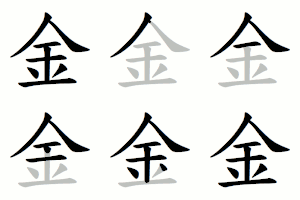 | |||
Han character
金 (Kangxi radical 167, 金+0, 8 strokes, cangjie input 金 (C), four-corner 80109, composition ⿱𫢉䒑)
- Kangxi radical #167, ⾦.
Derived characters
References
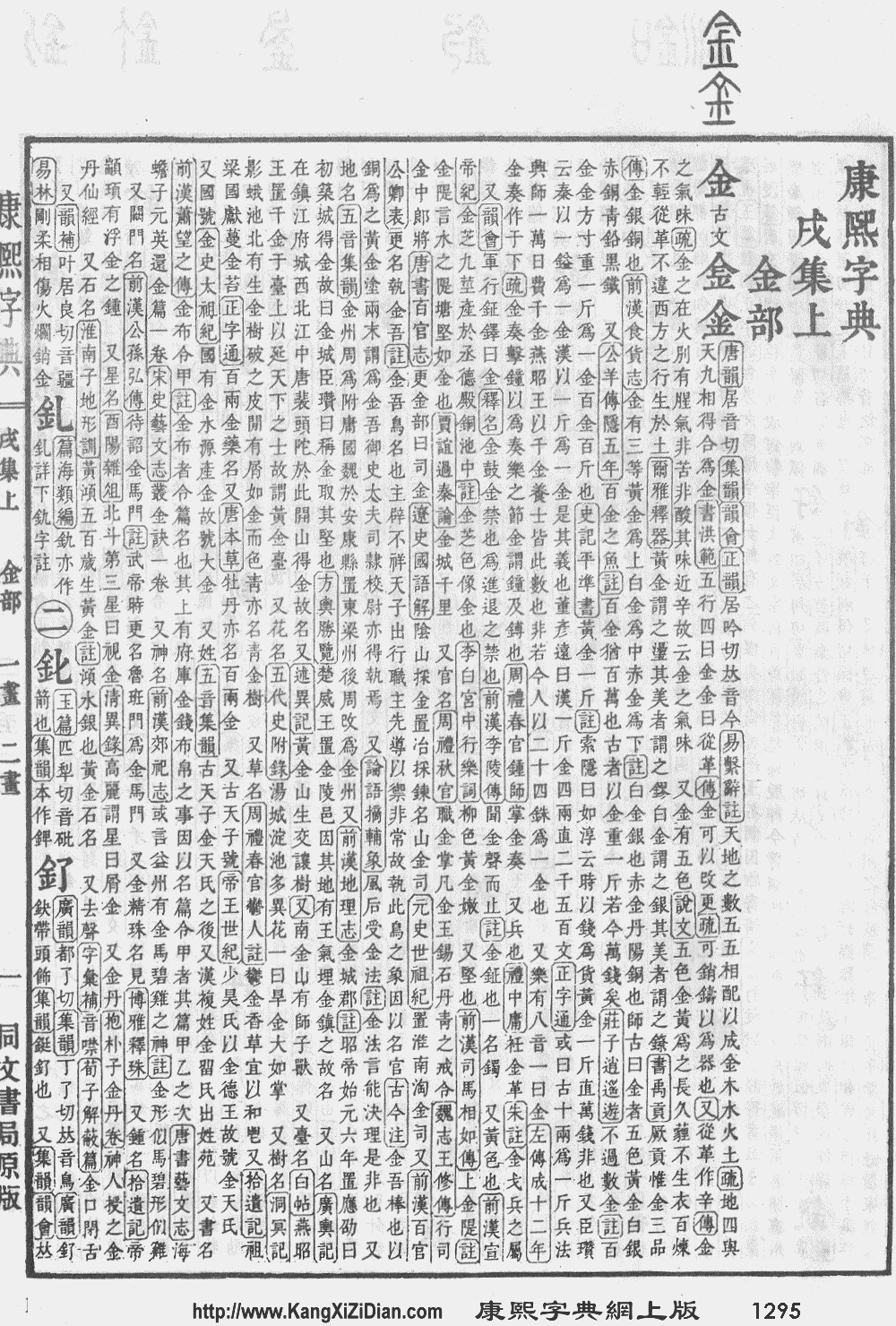
- KangXi: page 1295, character 1
- Dai Kanwa Jiten: character 40152
- Dae Jaweon: page 1795, character 13
- Hanyu Da Zidian (first edition): volume 6, page 4167, character 1
- Unihan data for U+91D1
- Unihan data for U+F90A
Chinese
| simp. and trad. |
金 | |
|---|---|---|
| alternative forms | 𠊍 𨤾 ⿳仺𭕄一 𠈘 𠉓 𠊍 𨤾 ⿳仺𭕄一 𠈘 𠉓 𨥀 𨥄 ⿱丿⿴囗⿱二水 | |
| Chemical element | |
|---|---|
| Au | |
| Previous: 鉑/铂 (bó) (Pt) | |
| Next: 汞 (gǒng) (Hg) | |

Glyph origin
| Historical forms of the character 金 | ||
|---|---|---|
| Western Zhou | Shuowen Jiezi (compiled in Han) | Liushutong (compiled in Ming) |
| Bronze inscriptions | Small seal script | Transcribed ancient scripts |
 |
 |
 |
Phono-semantic compound (形聲, OC *krɯm) : semantic 王 (“upside-down axe”) + semantic 呂 (“two blocks of metal”) + phonetic 亼. 亼 is the ancient form for 今 (OC *krɯm). Shuowen interprets it as an image of metal in the earth ('象金在土中形') with 亼 as phonetic.
Originally referred to copper. Later, the meaning was extended to metal as a whole, and then to gold.
Etymology
Starostin reconstructs Proto-Sino-Tibetan *gǝ̆m (“metal”); compare Tedim Chin xam (“gold”) and Lepcha [script needed] (kóm, “silver, coin, money”).
“Copper” [prior to 5th BCE] > “metals in general” > “gold”.
The main senses now are “gold” and “metal”.
Pronunciation
Definitions
金
- (obsolete) copper (Cu)
- metal
- 合金 ― héjīn ― alloy
- metalware
- gold (Au)
- golden; blond
- (by extension) money; material wealth
- (historical) ancient currency unit
- (historical) gong or other metalware for signalling commands in the military
- respectful; precious
- 金玉良言 ― jīnyùliángyán ― precious advice
- Used in 金城 (jīnchéng).
- Short for 金星 (Jīnxīng, “Venus”).
- one of the eight kinds of instruments (八音 (-))
- one of the five elements of Wu Xing (五行 (-))
- (~朝) (historical) The Jurchen Jin dynasty (1115–1234)
- (~朝, ~國) (historical) Synonym of 後金/后金 (Hòujīn), the Jurchen Later Jin state (1616–1636)
- a surname
Synonyms
Compounds
|
|
|
Descendants
Others:
References
- “Entry #4506”, in 臺灣閩南語常用詞辭典 [Dictionary of Frequently-Used Taiwan Minnan] (in Chinese and Min Nan), Ministry of Education, R.O.C., 2011.
Japanese
Kanji
| Chemical element | |
|---|---|
| Au | |
| Previous: 白金 (hakkin) (Pt) | |
| Next: 水銀 (suigin) (Hg) | |
 金 (kane, kana, kin): Metal in general, such as metal sheeting. |
 |
Readings
Etymology 1
| Kanji in this term |
|---|
| 金 |
| かな Grade: 1 |
| kun’yomi |
From Old Japanese. Appears to be the older form of this word. In modern Japanese, only found at the start of compounds.
Pronunciation
- IPA(key): [ka̠na̠]
Derived terms
- 金山 (kanayama): a mine (for mineral extraction)
- 金床 (kanatoko), 鉄床 (kanatoko), 鉄砧 (kanatoko): an anvil
- 金具 (kanagu): hardware, metal fittings
- 金串 (kanagushi): a metal skewer or spit
- 金轡 (kanagutsuwa): a metal bit (as for a horse's mouth); hush money, a bribe
- 金槌 (kanazuchi): a metal hammer
- 鉄棒 (kanabō): a metal rod or staff
- 金網 (kanaami): a metal mesh, net, or screen
Etymology 2
| Kanji in this term |
|---|
| 金 |
| かね Grade: 1 |
| kun’yomi |
| Alternative spellings |
|---|
| 銀 銅 鉄 |
From Old Japanese. Found in the Man'yōshū, completed some time after 759 CE.[1]
Appears to be a fusion of kana + Old Japanese emphatic nominal particle い (i). Compare the development of modern kami from kamu + i at 神, te from ta + i at 手, me from ma + i at 目, kaze from kaza + i at 風.
/kana/ + /i/ → /*kanai/ → /kane/
The four kanji spellings of this term, 金 (“gold”), 銀 (“silver”), 銅 (“copper”), and 鉄 (“iron”), hint at the importance of each of these four metals in ancient Japan.
Usage notes
The 金 spelling is the most common for this term.
Derived terms
Etymology 3
| Kanji in this term |
|---|
| 金 |
| くがね Grade: 1 |
| kun’yomi |
Compound of 黄 (ku, “yellow”) + 金 (kane, “metal”). The ku is a variation of regular kun'yomi of ki for the 黄 character.[4] The kane changes to gane as an instance of rendaku (連濁).
Alternative forms
Pronunciation
- IPA(key): [kɯ̟ᵝɡa̠ne̞]
Etymology 4
| Kanji in this term |
|---|
| 金 |
| こがね Grade: 1 |
| kun’yomi |
/kuɡane/ → /koɡane/
Alteration of kugane[4], possibly influenced by metaphor from 小金 (kogane, “a small amount of money”), or by the kan'on reading of kō for the 黄 character.
Alternative forms
Pronunciation
Noun
金 • (kogane)
See also
Etymology 5
| Kanji in this term |
|---|
| 金 |
| きん Grade: 1 |
| on’yomi |
From Middle Chinese 金 (kim). Compare modern Mandarin 金 (jīn).
Noun
金 • (kin)
Usage notes
Often found in compounds.
Derived terms
- 金魚 (kingyo): a goldfish
- 金魚草 (kingyosō): a snapdragon
- 金魚掬い (kingyosukui): goldfish scooping (a fairground game)
- 金属 (kinzoku): a metal, metallic
- 金帛 (kinpaku): gold and silk, money and cloths
- 半金属 (hankinzoku): metalloid
- 非金属 (hikinzoku): a nonmetal, nonmetallic
- 金管楽器 (kinkan gakki): a brass instrument
- 金塊 (kinkai): a gold nugget, bar, ingot, or bullion
- 金型 (kanegata): a die or mold
- 金曜日 (kin'yōbi): Friday
- 金字塔 (kinjitō): a pyramid or monument
- 金銭 (kinsen): money, cash
- 金額 (kingaku): an amount of money
- 金髪 (kinpatsu): blond hair
- 上金 (agegane): tribute paid by general commoners to daimyō in feudal Japan
- 一刻千金 (ikkoku senkin): time flies when you're having fun
- 益金 (ekikin): profit, proceeds
- 換金 (kankin): realization or conversion of goods into money, such as to cash a check
- 金融 (kin'yū): finance
- 消費者金融 (shōhisha kin'yū): consumer finance
- 現金 (genkin): cash
- 国庫金 (kokkokin): treasury funds (as of the central government)
- 合金 (gōkin): an alloy
- 砂金 (sakin): gold dust
- 資金 (shikin): capital, funds
- 資金洗浄 (shikin senjō): money laundering
- 資本金 (shihonkin): capital, capital stock
- 借入金 (shakunyūkin): borrowed money, debt payable, loan payable
- 賞金 (shōkin): prize money, a reward
- 上金 (jōkin): high-quality or high-purity gold
- 代金 (daikin): a rate, a price
- 賃金 (chingin): wages
- 年金 (nenkin): a pension, an annuity
- 白金 (hakkin): platinum
- 引当金 (hikiatekin): provision, reserves
- 預金 (yokin): a deposit (as in a bank account)
- 料金 (ryōkin): a fee
- 錬金術 (renkinjutsu): alchemy
Noun
金 • (kon)
- one of the five classical elements in traditional Chinese philosophy and medicine: see the "Wu Xing" entry on Wikipedia
References
- c. 759, Man'yōshū (book 14, poem 3560), text here
- 2006, 大辞林 (Daijirin), Third Edition (in Japanese), Tōkyō: Sanseidō, →ISBN
- 1998, NHK日本語発音アクセント辞典 (NHK Japanese Pronunciation Accent Dictionary) (in Japanese), Tōkyō: NHK, →ISBN
- 1988, 国語大辞典(新装版) (Kokugo Dai Jiten, Revised Edition) (in Japanese), Tōkyō: Shogakukan
Korean
Etymology 1
From Middle Chinese 金 (MC kˠiɪm).
| Historical Readings | ||
|---|---|---|
| Dongguk Jeongun Reading | ||
| Dongguk Jeongun, 1448 | 금 (Yale: kùm) | |
| Middle Korean | ||
| Text | Eumhun | |
| Gloss (hun) | Reading | |
| Hunmong Jahoe, 1527 | 쇠〮 (Yale: swóy) | 금 (Yale: kùm) |
Pronunciation
- (SK Standard/Seoul) IPA(key): [kɯm]
- Phonetic hangul: [금]
Compounds
- 갹금 (醵金, gyakgeum)
- 거금 (巨金, geogeum)
- 거금 (醵金, geogeum)
- 금고 (金庫, geumgo)
- 금리 (金利, geumni)
- 금박 (金箔, geumbak)
- 금발 (金髪, geumbal)
- 금성 (金星, geumseong)
- 금속 (金屬, geumsok)
- 금융 (金融, geumyung)
- 금전 (金錢, geumjeon)
- 금품 (金品, geumpum)
- 과금 (課金, gwageum)
- 기금 (基金, gigeum)
- 대금 (代金, daegeum)
- 도금 (鍍金, dogeum)
- 모금 (募金, mogeum)
- 만금 (萬金, man'geum)
- 백금 (白金, baekgeum)
- 벌금 (罰金, beolgeum)
- 상금 (賞金, sanggeum)
- 세금 (稅金, segeum)
- 송금 (送金, songgeum)
- 연금 (年金, yeon'geum)
- 예금 (預金, yegeum)
- 요금 (料金, yogeum)
- 원금 (元金, won'geum)
- 임금 (賃金, imgeum)
- 입금 (入金, ipgeum)
- 자금 (資金, jageum)
- 저금 (貯金, jeogeum)
- 판금 (板金, pan'geum)
- 합금 (合金, hapgeum)
- 헌금 (獻金, heon'geum)
- 현금 (現金, hyeon'geum)
- 황금 (黃金, hwanggeum)
- 과징금 (課徵金, gwajinggeum)
- 금강산 (金剛山, ^geumgangsan)
- 금요일 (金曜日, geumyoil)
- 금자탑 (金字塔, geumjatap)
- 기부금 (寄附金, gibugeum)
- 등록금 (登錄金, deungnokgeum)
- 범칙금 (犯則金, beomchikgeum)
- 보조금 (補助金, bojogeum)
- 비자금 (祕資金, bijageum)
- 잉여금 (剩餘金, ing'yeogeum)
- 장학금 (奬學金, janghakgeum)
- 중금속 (重金屬, junggeumsok)
- 추징금 (追徵金, chujinggeum)
- 후원금 (後援金, huwon'geum)
Etymology 2
Most likely a borrowing from Early Mandarin 金 (EM *kim) during Mongol rule in the thirteenth and fourteenth centuries.[1]
Pronunciation
- (SK Standard/Seoul) IPA(key): [kim]
- Phonetic hangul: [김]
Hanja
Vietnamese
Han character
金: Hán Việt readings: kim[1][2][3]
金: Nôm readings: kim[1][2][4], ghim[3][5], câm[2], găm[3], ghim[4]
References
- Nguyễn (2014).
- Nguyễn et al. (2009).
- Trần (2004).
- Taberd & Pigneau de Béhaine (1838).
- Hồ (1976).