安
| ||||||||
Translingual
| Stroke order | |||
|---|---|---|---|
 | |||
| Stroke order | |||
|---|---|---|---|
 | |||
Han character
安 (Kangxi radical 40, 宀+3, 6 strokes, cangjie input 十女 (JV), four-corner 30404, composition ⿱宀女)
Derived characters
Descendants
- あ (Hiragana character derived from man'yōgana)
References
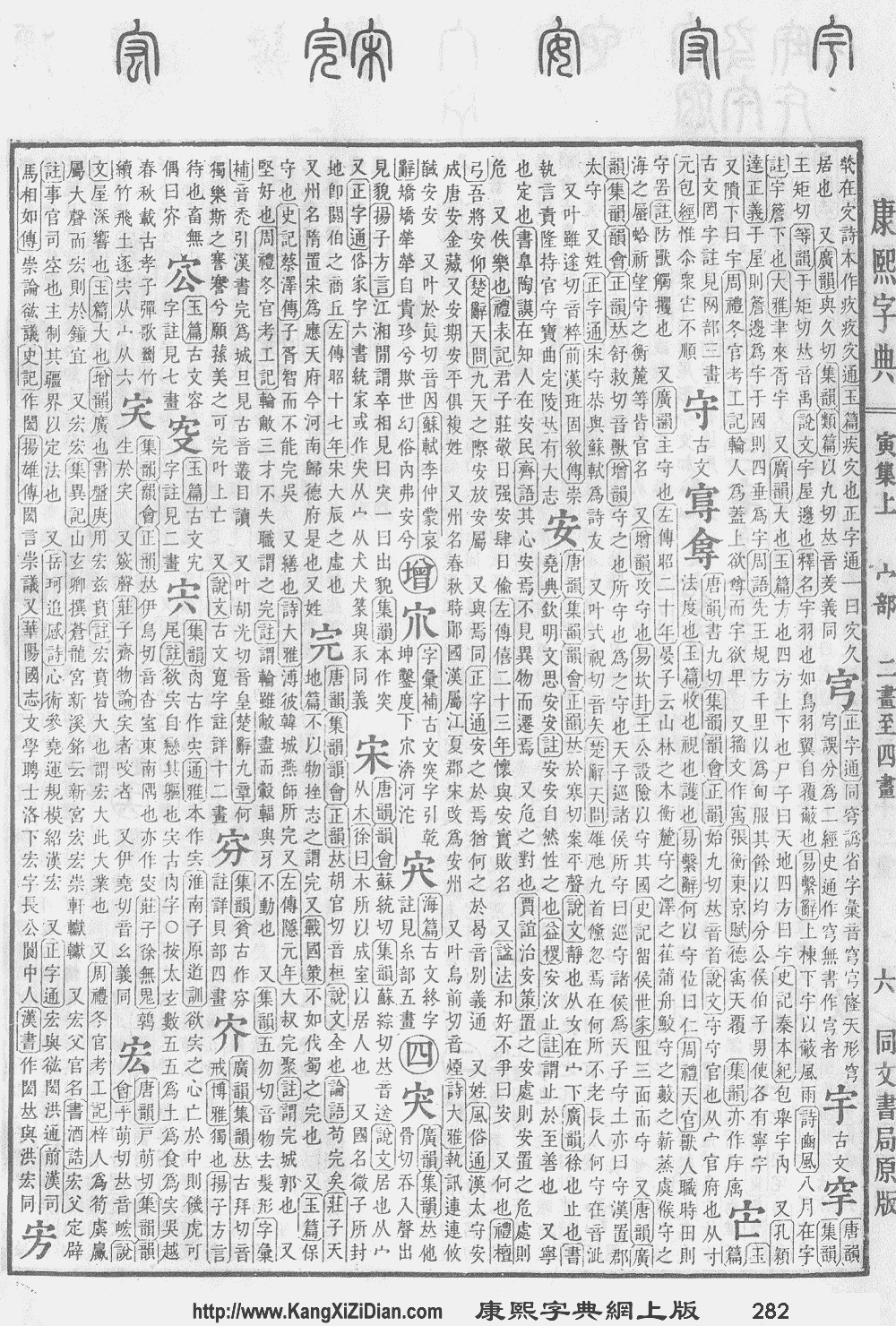
- KangXi: page 282, character 8
- Dai Kanwa Jiten: character 7072
- Dae Jaweon: page 552, character 5
- Hanyu Da Zidian (first edition): volume 2, page 913, character 9
- Unihan data for U+5B89
Chinese
| trad. | 安 | |
|---|---|---|
| simp. # | 安 | |
| alternative forms | 侒 𠕷 𭑨 𡚴 | |
Glyph origin
| Historical forms of the character 安 | |||
|---|---|---|---|
| Shang | Western Zhou | Shuowen Jiezi (compiled in Han) | Liushutong (compiled in Ming) |
| Oracle bone script | Bronze inscriptions | Small seal script | Transcribed ancient scripts |
 |
 |
 |
 |
Characters in the same phonetic series (安) (Zhengzhang, 2003)
Ideogrammic compound (會意) : 宀 (“house”) + 女 (“a woman or a kneeling person”) – person in a kneeling position sitting on the heels at home.
Etymology
- calm; peaceful
- A parallel stem is 宴 (OC *qeːns, “to be at ease; to rest”) (Wang, 1982; Schuessler, 2007).
- Cognate with 按 (OC *qaːns, “to push down with hand”), an exoactive derivative, literally “to cause to be settled; calmed” (ibid.).
- Starostin reconstructs Proto-Sino-Tibetan *ʔɨāɫ (“rest”), comparing it to Mizo âwl (“to rest”) (and also noting Dhimal [script needed] (el-ka, “good”)). STEDT, however, traces the Mizo word to Proto-Sino-Tibetan *s-grwal ~ *ʔwal (“finish, loose, relax”) and did not list 安 (OC *qaːn) among its comparanda: namely 完 (OC *ɦŋoːn), 緩 (OC *ɢʷaːnʔ), 諼 (OC *qʰʷan, *qʰʷanʔ), 援 (OC *ɢʷans, *ɢʷan).
Pronunciation
Definitions
安
- calm; peaceful; tranquil; quiet
- comfortable; at ease
- 安逸 ― ānyì ― easy and comfortable
- 君子食無求飽,居無求安。 [Classical Chinese, trad.]
- From: The Analects of Confucius, c. 475 – 221 BCE, translated based on James Legge's version
- Jūnzǐ shí wú qiú bǎo, jū wú qiú ān. [Pinyin]
- He who aims to be a man of complete virtue in his food does not seek to gratify his appetite, nor in his dwelling place does he seek the appliances of ease.
君子食无求饱,居无求安。 [Classical Chinese, simp.]
- safe; secure
- 是故君子安而不忘危,存而不忘亡,治而不忘亂;是以身安而國家可保也。 [Pre-Classical Chinese, trad.]
- From: I Ching, 11th – 8th century BCE
- Shìgù jūnzǐ ān ér bù wàng wēi, cún ér bù wàng wáng, zhì ér bù wàng luàn; shìyǐ shēn ān ér guójiā kě bǎo yě. [Pinyin]
- Therefore the superior man, when resting in safety, does not forget that danger may come; when in a state of security, he does not forget the possibility of ruin; and when all is in a state of order, he does not forget that disorder may come. Thus his person is kept safe, and his states and all their clans can be preserved.
是故君子安而不忘危,存而不忘亡,治而不忘乱;是以身安而国家可保也。 [Pre-Classical Chinese, simp.]
- to calm; to pacify
- to feel satisfied with
- to find a place for; to plant
- to fit; to install
- to cherish; to harbour
- to confer (a title); to bestow; to put (the blame on someone)
- (literary) where
- 沛公安在? [Classical Chinese, trad. and simp.]
- From: The Records of the Grand Historian, by Sima Qian, c. 91 BCE
- Pèigōng ān zài? [Pinyin]
- Where is Pei Gong (Liu Bang)?
- (literary) how; why
- 雄兔腳撲朔,雌兔眼迷離。兩兔傍地走,安能辨我是雄雌? [Classical Chinese, trad.]
- From: 《木蘭詩》; translation by Jack Yuan
- Xióng tù jiǎo pūshuò, cí tù yǎn mílí. Liǎng tù bàng dì zǒu, ān néng biàn wǒ shì xióng cí? [Pinyin]
- The buck bounds here and there, whilst the doe has narrow eyes. But when the two rabbits run side by side, how can you tell the female from the male?
雄兔脚扑朔,雌兔眼迷离。两兔傍地走,安能辨我是雄雌? [Classical Chinese, simp.]
- (physics) Short for 安培 (ānpéi, “ampere”).
- Short for 安非他命 (ānfēitāmìng, “amphetamine”).
- 吸安 ― xī'ān ― to use amphetamine (illegally)
- a surname
Compounds
Derived terms from 安
|
|
|
Descendants
Japanese
Readings
Derived terms
Compounds
- 塩安 (en'an): ammonium chloride
- 硝安 (shōan): ammonium nitrate
- 炭安 (tan'an): ammonium carbonate
- 硫安 (ryūan): ammonium sulphate
- 燐安 (rin'an): ammonium phosphate
- 安易 (an'i)
- 安逸 (an'itsu)
- 安穏 (annon)
- 安危 (anki)
- 安心 (anshin), 安心 (anjin)
- 安息 (ansoku)
- 安泰 (antai)
- 安置 (anchi)
- 安直 (anchoku)
- 安堵 (ando)
- 安寧 (annei)
- 安否 (anpi)
- 安眠 (anmin)
- 安楽 (anraku)
- 安宿 (yasuyado)
Korean
Etymology
(This etymology is missing or incomplete. Please add to it, or discuss it at the Etymology scriptorium. Particularly: “Middle Korean readings, if any”)
Pronunciation
- (SK Standard/Seoul) IPA(key): [a̠n]
- Phonetic hangul: [안]
Vietnamese
Han character
安: Hán Việt readings: an[1][2][3][4][5], yên[4][5]
安: Nôm readings: yên[1][2][3][6][4][7], an[1][2][4][7], án[1], ăn[1]
Compounds
References
- Nguyễn (2014).
- Nguyễn et al. (2009).
- Trần (2004).
- Bonet (1899).
- Génibrel (1898).
- Hồ (1976).
- Taberd & Pigneau de Béhaine (1838).
Zhuang
References
- 古壮字字典 [Dictionary of Old Zhuang Characters], Guangxi: Ethnic Publishing House (广西民族出版社), 2012, →ISBN, page 1
This article is issued from Wiktionary. The text is licensed under Creative Commons - Attribution - Sharealike. Additional terms may apply for the media files.