弄
| ||||||||
| ||||||||
Translingual
| Stroke order | |||
|---|---|---|---|
 | |||
Han character
弄 (Kangxi radical 55, 廾+4, 7 strokes, cangjie input 一土廿 (MGT), four-corner 10441, composition ⿱王廾)
References
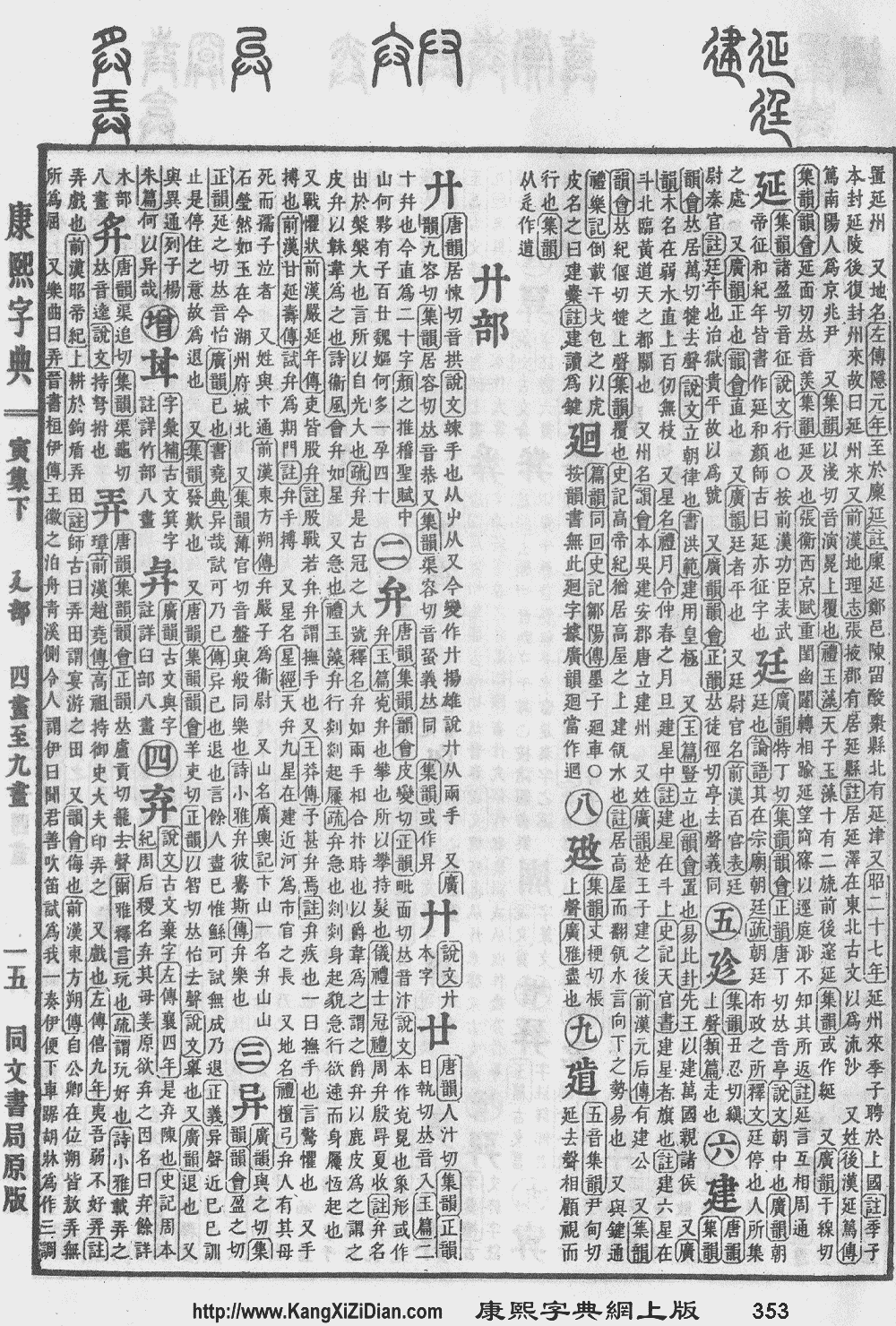
- KangXi: page 353, character 17
- Dai Kanwa Jiten: character 9596
- Dae Jaweon: page 669, character 1
- Hanyu Da Zidian (first edition): volume 1, page 515, character 1
- Unihan data for U+5F04
- Unihan data for U+F943
Chinese
Glyph origin
Characters in the same phonetic series (弄) (Zhengzhang, 2003)
Ideogrammic compound (會意) : 玉 (“jade”) + 廾 (“hands”) – play with a jade artefact using one's hands.
Etymology 1
| simp. and trad. |
弄 | |
|---|---|---|
| alternative forms | 挵 挊 | |
Compared with Khmer លួង (luəng, “to console; to cheer; to coax; to flatter”) < Old Khmer lvaṅ (“to cheer, amuse, entertain, divert”) < Pre-Angkorian Khmer loṅ. The Khmer initial consonant does not agree with Old Chinese; perhaps the Khmer word is a post-Han loan (Schuessler, 2007).
Pronunciation
Definitions
弄
- to play with; to play around with; to fiddle with; to fondle
- to enjoy; to play
- trick; magic
- to make fun of; to tease; to bully
- to show off; to make a show of
- (Min Nan) to amuse (a child)
- (music) to play (a musical instrument); to perform
- (music) ditty
- to do; to engage in; to undertake; to deal with
- to make ... do/become ...; to cause ... to do ...
- (colloquial) to cause someone to become pregnant
- (Min Nan) to shake off; to shake out
- to marry
- to investigate; to look into
- to get; to obtain; to fetch
- to decorate; to dress up; to put on make-up
Compounds
Derived terms from 弄
|
|
|
Etymology 2
| simp. and trad. |
弄 | |
|---|---|---|
| alternative forms | 衖 | |
Possibly from an ancient regional variant of 巷 (OC *ɡroːŋs, “alley”).
Pronunciation
Definitions
弄
Synonyms
Dialectal synonyms of 衚衕 (“alley; lane”) [map]
Pronunciation
Definitions
弄
Synonyms
Dialectal synonyms of 玩 (“to play; to play with”) [map]
Further reading
- (Min Nan pronunciation audio) “Entry #3143”, in 臺灣閩南語常用詞辭典 [Dictionary of Frequently-Used Taiwan Minnan] (in Chinese and Min Nan), Ministry of Education, R.O.C., 2011.
Japanese
Korean
Vietnamese
This article is issued from Wiktionary. The text is licensed under Creative Commons - Attribution - Sharealike. Additional terms may apply for the media files.