肩
| ||||||||
Translingual
| Japanese | 肩 |
|---|---|
| Simplified | 肩 |
| Traditional | 肩 |
Alternative forms
The form differs between traditional Chinese, simplified Chinese, and Japanese shinjitai, as depicted at right. These are represented by the same Unicode code point; see Han unification.
Han character
肩 (Kangxi radical 130, 肉+4, 8 strokes, cangjie input 竹尸月 (HSB) or 戈尸月 (ISB), four-corner 30227, composition ⿸戶月 or ⿸户月 or ⿸戸月)
References
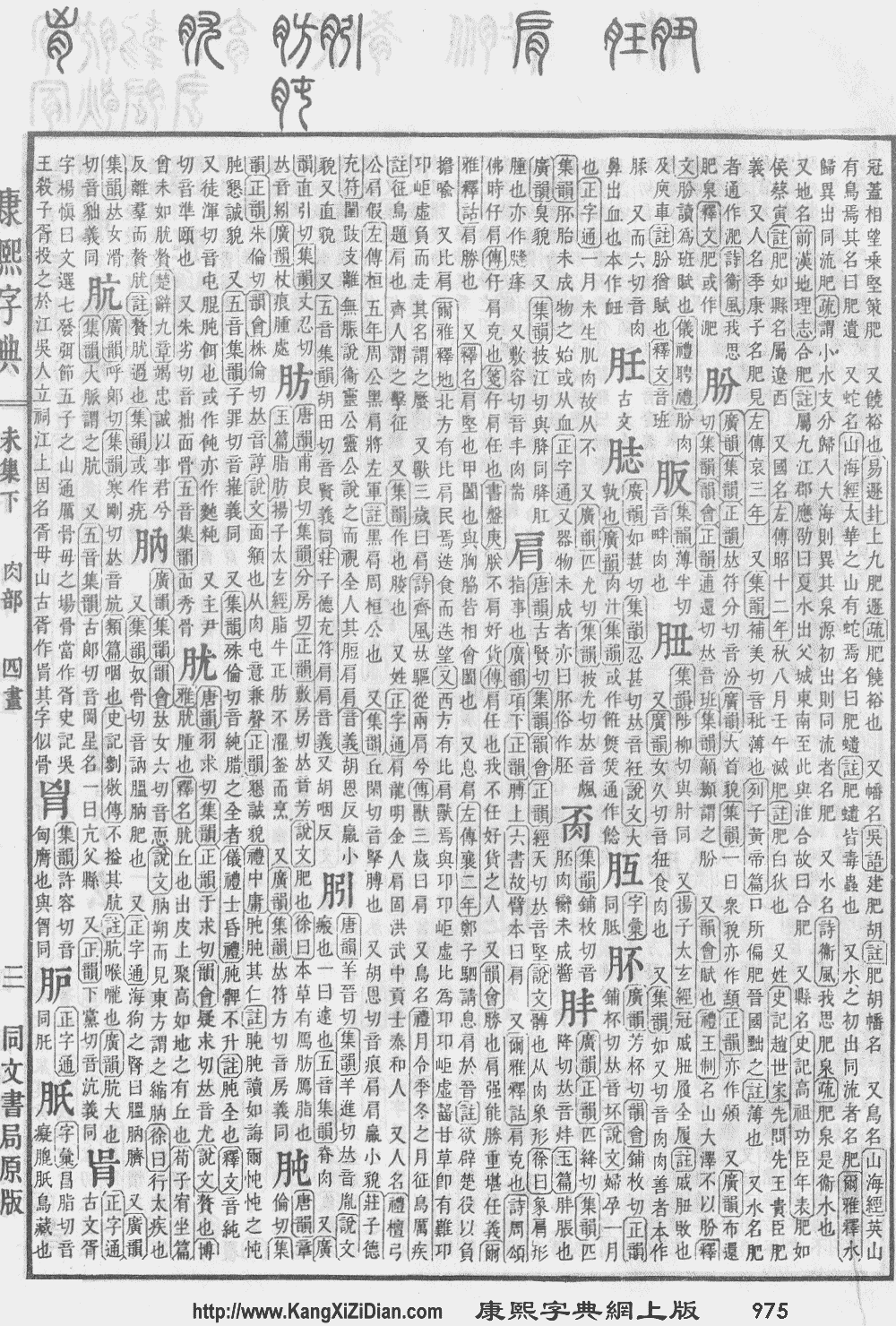
- KangXi: page 975, character 10
- Dai Kanwa Jiten: character 29299
- Dae Jaweon: page 1426, character 21
- Hanyu Da Zidian (first edition): volume 3, page 2052, character 8
- Unihan data for U+80A9
Chinese
| trad. | 肩 | |
|---|---|---|
| simp. # | 肩 | |
Glyph origin
| Historical forms of the character 肩 | ||||||
|---|---|---|---|---|---|---|
| Shuowen Jiezi (compiled in Han) | Liushutong (compiled in Ming) | |||||
| Small seal script | Transcribed ancient scripts | |||||
 |
 | |||||
|
|
References: Mostly from Richard Sears' Chinese Etymology site (authorisation),
| ||||||

Etymology
Cognate with Proto-Kam-Sui *k-xiːn¹ (“arm”), Proto-Tai *qeːnᴬ (“arm”) (whence Thai แขน (kɛ̌ɛn, “arm”)) (Schuessler, 2007).
Alternatively, possibly from Proto-Sino-Tibetan *k(w/y)an (“shoulder”).
Pronunciation
Definitions
肩
- shoulders
- 歷史已經證明:中國資產階級是不能盡此責任的,這個責任就不得不落在無產階級的肩上了。 [MSC, trad.]
- From: 1940, 毛澤東 (Mao Zedong), 《新民主主義論》 (On New Democracy), 《毛澤東選集》. English translation based on the Foreign Languages Press edition
- Lìshǐ yǐjīng zhèngmíng: Zhōngguó zīchǎnjiējí shì bùnéng jìn cǐ zérèn de, zhège zérèn jiù bùdébù luòzài wúchǎnjiējí de jiān shàng le. [Pinyin]
- History has proved that the Chinese bourgeoisie cannot fulfil this responsibility, which inevitably falls upon the shoulders of the proletariat.
历史已经证明:中国资产阶级是不能尽此责任的,这个责任就不得不落在无产阶级的肩上了。 [MSC, simp.]
- to shoulder; to undertake; to take on
- to bear
Synonyms
- (shoulders):
- (to bear):
Compounds
|
|
References
- “肩”, in 漢語多功能字庫 (Multi-function Chinese Character Database), 香港中文大學 (the Chinese University of Hong Kong), 2014–
Japanese
| Shinjitai | 肩 | |
| Kyūjitai [1] |
肩󠄁 肩+ 󠄁?(Adobe-Japan1) |
 |
| 肩󠄃 肩+ 󠄃?(Hanyo-Denshi) (Moji_Joho) | ||
| The displayed kanji may be different from the image due to your environment. See here for details. | ||
Noun
肩 • (kata)
- a shoulder
- 2013 April 7 [Dec 9 2012], ONE; Murata, Yusuke, “3撃目 災害存在 [3rd Hit: Existential Crisis]”, in ONEPUNCH-MAN [One-Punch Man], volume 1 (fiction), 6th edition, Tokyo: Shueisha, →ISBN, page 53:
- 肩!肩に 肩に乗ってる奴を殺せ‼
- Kata! Kata ni Kata ni notteru yatsu o korose‼
- Shoulder! Your shoulder! Kill the bastard on your shoulder!!
- 肩!肩に 肩に乗ってる奴を殺せ‼
-
References
- “肩”, in 漢字ぺディア (Kanjipedia) (in Japanese), 日本漢字能力検定協会, 2015—2023
- 1974, 新明解国語辞典 (Shin Meikai Kokugo Jiten), Second Edition (in Japanese), Tōkyō: Sanseidō
- 1997, 新明解国語辞典 (Shin Meikai Kokugo Jiten), Fifth Edition (in Japanese), Tōkyō: Sanseidō, →ISBN
- 2006, 大辞林 (Daijirin), Third Edition (in Japanese), Tōkyō: Sanseidō, →ISBN
- 1998, NHK日本語発音アクセント辞典 (NHK Japanese Pronunciation Accent Dictionary) (in Japanese), Tōkyō: NHK, →ISBN
Korean
Etymology
From Middle Chinese 肩 (MC ken). Recorded as Middle Korean 견 (kyen) (Yale: kyen) in Hunmong Jahoe (訓蒙字會 / 훈몽자회), 1527.