肉
| ||||||||
| ||||||||
Translingual
| Stroke order | |||
|---|---|---|---|
 | |||
| Stroke order | |||
|---|---|---|---|
 | |||
Alternative forms
- ⺼ U+2EBC (when used as a left Chinese radical in compositions)
The left component form ⺼ looks very similar to ⺝, the left radical form of 月 (“moon”), and is often drawn identically in compounds. However they are etymologically distinct, and careful usage distinguishes the cross strokes, with ⺼ written with unattached diagonal strokes. This is particularly an issue in looking up characters by radical; compare 月 index and 肉 index.
The radical form ⺼ may also appear twisted to a diagonal, resembling 夕 with an added line, as in 祭, 然, and 將.
Han character
肉 (Kangxi radical 130, 肉+0, 6 strokes, cangjie input 人月人 (OBO), four-corner 40227, composition ⿵内人 or ⿻冂仌)
- Kangxi radical #130, ⾁.
Derived characters
References
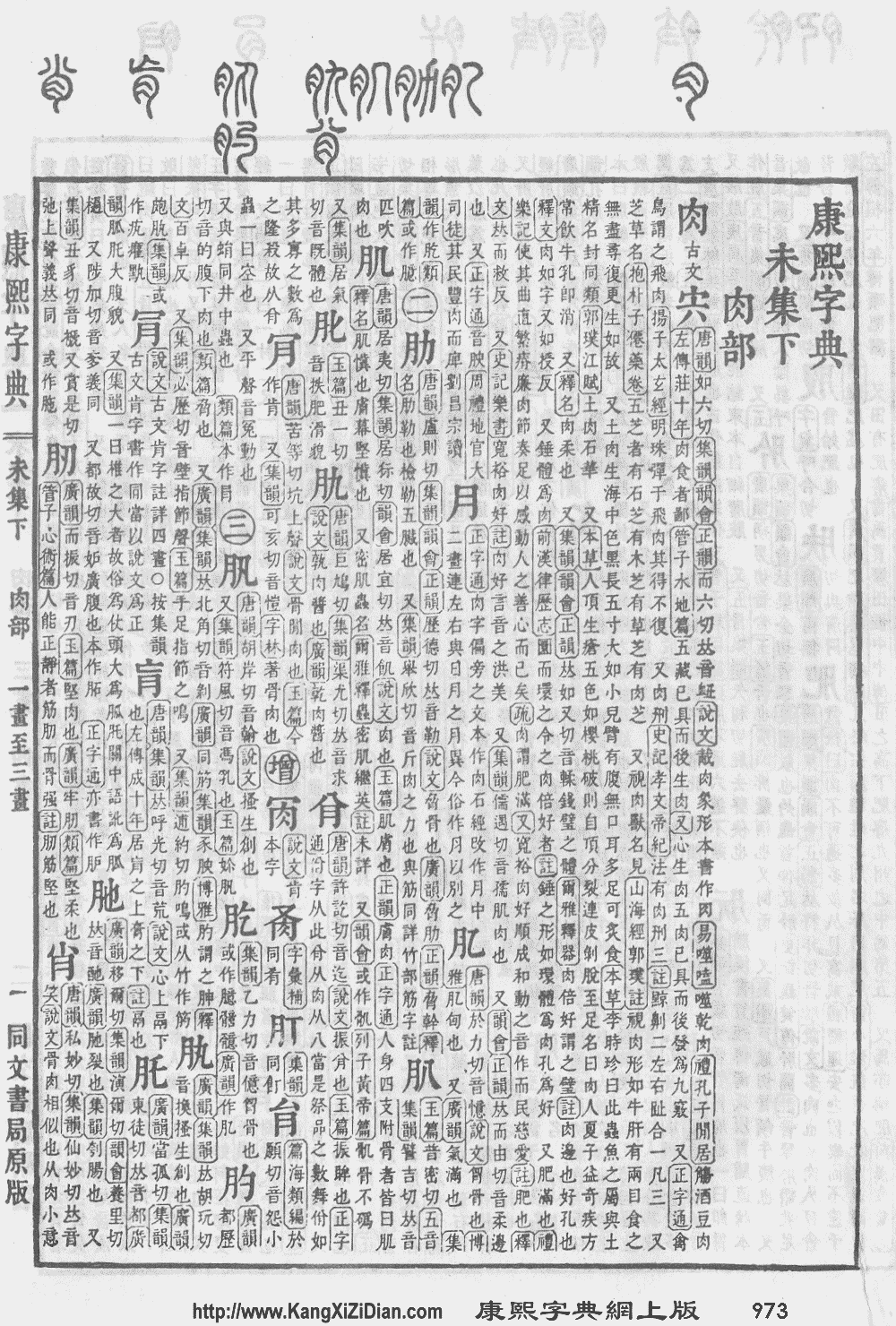
- KangXi: page 973, character 1
- Dai Kanwa Jiten: character 29236
- Dae Jaweon: page 1424, character 4
- Hanyu Da Zidian (first edition): volume 5, page 2931, character 1
- Unihan data for U+8089
Chinese
| simp. and trad. |
肉 | |
|---|---|---|
| alternative forms | ||
Glyph origin
| Historical forms of the character 肉 | ||||||
|---|---|---|---|---|---|---|
| Shang | Western Zhou | Warring States | Shuowen Jiezi (compiled in Han) | Liushutong (compiled in Ming) | Libian (compiled in Qing) | |
| Oracle bone script | Bronze inscriptions | Chu slip and silk script | Qin slip script | Small seal script | Transcribed ancient scripts | Clerical script |
 |
 |
 |
 |
 |
 |
 |
Pictogram (象形) – ribs of an animal’s torso or simply a physical representation of a slice of meat.
Etymology 1
Probably from Proto-Sino-Tibetan *now (“tender; soft”), which has also been compared to 柔 (OC *mlju, “soft; flexible”), 揉 (OC *mju, “to knead”), 軟 (OC *njonʔ, “soft”), 弱 (OC *njewɢ, “weak”), 懦 (OC *noːls, *njo, “cowardly”), 荏 (OC *njɯmʔ, “weak”) (STEDT; Schuessler, 2007). Alternatively, it may be from Proto-Sino-Tibetan *s-nja-k (“meat, flesh”) (STEDT).
- "media"
- Back-formation from 生肉 (shēngròu). See there for more.
Pronunciation
Definitions
肉
Compounds
|
|
|
Descendants
Pronunciation
Definitions
肉
- (archaic) edge; brim; an outer part of a ring-shaped object (such as coin or jade annulus)
- (archaic, of sound and music) rich; substantial
- 使其曲直繁瘠,廉肉節奏,足以感動人之善心而已矣。 [Classical Chinese, trad.]
- From: The Records of the Grand Historian, by Sima Qian, c. 91 BCE
- Shǐ qí qūzhí fánjí, liánròu jiézòu, zúyǐ gǎndòng rén zhī shànxīn ér yǐyǐ. [Pinyin]
- (please add an English translation of this example)
使其曲直繁瘠,廉肉节奏,足以感动人之善心而已矣。 [Classical Chinese, simp.]
- (dialectal Mandarin) spongy; squashy; flabby
- (dialectal Mandarin) slow; sluggish
Compounds
|
|
Descendants
Etymology 3
| simp. and trad. |
肉 | |
|---|---|---|
| alternative forms | 脈/脉 𬁲 | |
Unclear. Reminiscent of 脢 (OC *mɯːs, *mɯː, *mɯːs, “dorsal meat”) (Schuessler, 2007).
Alternatively, it may be of substrate origin. Compare (Deng, 1994):
Pronunciation
Definitions
- meat; flesh
- 豬肉/猪肉 [Hokkien] ― ti-bah [Pe̍h-ōe-jī] ― pork
- 牛肉 [Hokkien] ― gû-bah [Pe̍h-ōe-jī] ― beef
- (specifically) pork
- 肉骨 [Hokkien] ― bah-kut [Pe̍h-ōe-jī] ― pork ribs
- flesh; pulp
- 龍眼乾肉/龙眼干肉 [Hokkien] ― lêng-géng-koaⁿ bah [Pe̍h-ōe-jī] ― flesh of dried longan
- main part of an object
- 刀肉 [Hokkien] ― to-bah [Pe̍h-ōe-jī] ― blade of a knife or sword
Further reading
- “肉”, in 漢語多功能字庫 (Multi-function Chinese Character Database), 香港中文大學 (the Chinese University of Hong Kong), 2014–
- Dictionary of Chinese Character Variants (教育部異體字字典), A03288
- “Entry #2607”, in 臺灣閩南語常用詞辭典 [Dictionary of Frequently-Used Taiwan Minnan] (in Chinese and Min Nan), Ministry of Education, R.O.C., 2011.
- (Cantonese) 粵音資料集叢
- zi.tools
Japanese
Etymology 1
| Kanji in this term |
|---|
| 肉 |
| しし Grade: 2 |
| kun’yomi |
From Old Japanese, from Proto-Japonic *sisi. Not used in isolation in modern Japanese. Persists in compounds.
Cognate with 獣 (shishi, “beast, especially one used for meat”).
Noun
肉 • (shishi)
Derived terms
- 肉合い (shishiai): how someone or something is fleshed out, one's build
- 肉置き (shishioki): how someone or something is fleshed out, one's build
- 肉付き (shishitsuki): how someone or something is fleshed out, one's build
- 肉付く (shishizuku): to become fatter, to become meatier; to make someone or something fatter or meatier
- 肉醤 (shishibishio): salted meat, salted fish; the salted and mummified body of an executed person, a practice of punishment carried out in ancient China
- 肉骨 (shishibone): bones from which the meat has been removed; a skeleton
- 肉叢 (shishimura): a cut or hunk of meat; the physical or corporeal body, the flesh
- 肉病 (shishiyami): (rare) obesity, a disease whereby the body becomes fat
Etymology 2
| Kanji in this term |
|---|
| 肉 |
| にく Grade: 2 |
| on’yomi |
From Middle Chinese 肉 (*njiuk). Compare modern Min Nan 肉 (jiok8) or Hakka 肉 (ngiuk7).
Alternative forms
- (honorific) お肉 (o-niku)
Noun
肉 • (niku)
- meat, the muscle and fat tissue of an animal used as food
- the flesh of an animal
- the flesh of a fruit or vegetable
- one's body, as opposed to spirit
- the thickness of a thing
- 板の肉
- ita no niku
- the thickness of a board
- 板の肉
- (figurative) the flesh or meat of something, such as an idea, structure, or argument
- 議論に肉をつける
- giron ni niku o tsukeru
- to put some meat on an argument, to flesh out an argument
- 議論に肉をつける
- an ink pad, a stamp pad
- (theater, kabuki) short for 肉襦袢 (niku juban): flesh-toned undergarments worn by actors and shown when the character has to display their skin
Synonyms
Derived terms
- 牛肉 (gyūniku): beef
- 狗肉 (kuniku): dog meat
- 鶏肉 (keiniku), 鶏肉 (toriniku): chicken (meat)
- 鯨肉 (geiniku): whale meat
- 鳥肉 (toriniku): meat of a bird, in particular meat of a chicken
- 肉交 (nikukō): sexual intercourse
- 筋肉 (kinniku): muscle
- 肉羹 (nikukō): meat broth
- 肉汁 (nikujū): meat broth; meat juice; gravy
- 肉漿 (nikushō): meat juice
- 肉饅 (nikuman): nikuman
- 肉饅頭 (nikumanjū): nikuman
- 肉類 (nikurui): a kind of meat, the sort of meat
- 馬肉 (baniku): horsemeat
- 豚肉 (butaniku), 豚肉 (tonniku): pork
- 挽肉 (hikiniku): minced meat, ground meat
- 羊肉 (yōniku): mutton
- すじ肉 (sujiniku)