患

患 U+60A3, 患
CJK UNIFIED IDEOGRAPH-60A3
← 悢
[U+60A2]
CJK Unified Ideographs 悤 →
[U+60A4]

Translingual

Han character

患 (Kangxi radical 61, 心+7, 11 strokes, cangjie input 中中心 (LLP), four-corner 50336, composition ⿱串心)

References

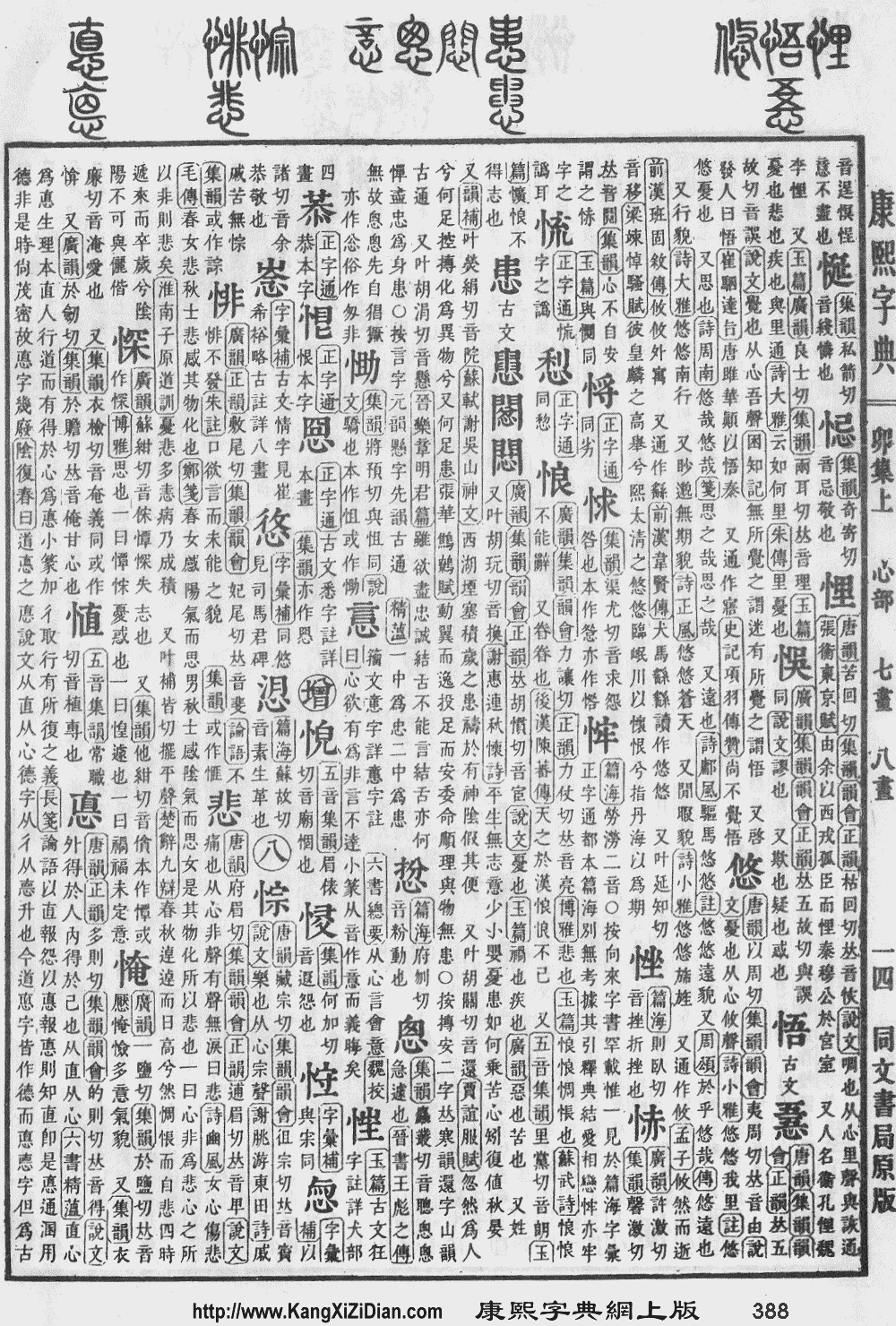
  • KangXi: page 388, character 16
  • Dai Kanwa Jiten: character 10691
  • Dae Jaweon: page 721, character 8
  • Hanyu Da Zidian (first edition): volume 4, page 2300, character 9
  • Unihan data for U+60A3

Chinese

simp. and trad.
患
alternative forms 𢠶
𢤒

Glyph origin

Phono-semantic compound (形聲, OC *ɡroːns) : phonetic 串 (OC *kroːns, *kʰjons) + semantic 心 (“heart”).

Since Shuowen does not have the character 串, it interprets the character as phonetic 吅 (OC *qʰon, *sqʰon, *sɢoŋs) + semantic 丨 + semantic 心 (“heart”) – to pierce through something from the heart. Duan Yucai claims in his commentary that older copies of Shuowen actually have phonetic 毌 (OC *koːn, *koːns, “to pierce through”) + semantic 心 (“heart”) instead.

Pronunciation


Note:
  • huam6 - Chaozhou;
  • huang6 - Shantou, Chenghai, Raoping, Puning.

Rime
Character 患
Reading # 1/1
Initial (聲) 匣 (33)
Final (韻) 刪 (70)
Tone (調) Departing (H)
Openness (開合) Closed
Division (等) II
Fanqie 胡慣切
Reconstructions
Zhengzhang
Shangfang
/ɦˠuanH/
Pan
Wuyun
/ɦʷᵚanH/
Shao
Rongfen
/ɣuɐnH/
Edwin
Pulleyblank
/ɦwaɨnH/
Li
Rong
/ɣuanH/
Wang
Li
/ɣwanH/
Bernard
Karlgren
/ɣwanH/
Expected
Mandarin
Reflex
huàn
Expected
Cantonese
Reflex
waan6
Baxter–Sagart system 1.1 (2014)
Character 患
Reading # 1/1
Modern
Beijing
(Pinyin)
huàn
Middle
Chinese
‹ hwænH ›
Old
Chinese
/*[ɡ]ˁro[n]-s/
English calamity; distress

Notes for Old Chinese notations in the Baxter–Sagart system:

* Parentheses "()" indicate uncertain presence;
* Square brackets "[]" indicate uncertain identity, e.g. *[t] as coda may in fact be *-t or *-p;
* Angle brackets "<>" indicate infix;
* Hyphen "-" indicates morpheme boundary;

* Period "." indicates syllable boundary.
Zhengzhang system (2003)
Character 患
Reading # 1/1
No. 5364
Phonetic
component
患
Rime
group
元
Rime
subdivision
3
Corresponding
MC rime
患
Old
Chinese
/*ɡroːns/
Notes 本從串(毌)聲

Definitions

患

  1. to contract (an illness); to suffer from; to be afflicted with
  2. (literary, or in compounds) disease; illness
  3. (literary, or in compounds) to worry; to feel anxious
  4. (literary, or in compounds) disaster; calamity; catastrophe

Synonyms

  • (to contract an illness):
  • (disease):
  • (to worry):
  • (disaster):

Compounds

Japanese

Kanji

患

(common “Jōyō” kanji)

  1. afflicted

Readings

Etymology

Kanji in this term
患
かん
Grade: S
on’yomi

From Middle Chinese 患 (MC ɦˠuanH).

Pronunciation

Affix

患(かん) • (kan) ←くわん (kwan)?

  1. worry; suffer
  2. afflicted

Noun

患(かん) • (kan) ←くわん (kwan)?

  1. trouble; worries; pain
  2. illness; sickness

References

  1. 2006, 大辞林 (Daijirin), Third Edition (in Japanese), Tōkyō: Sanseidō, →ISBN

Korean

Hanja

患 (eumhun 근심 환 (geunsim hwan))

  1. Hanja form? of 환 (“worry”).

Vietnamese

Han character

患: Hán Nôm readings: hoạn

  1. This term needs a translation to English. Please help out and add a translation, then remove the text {{rfdef}}.
This article is issued from Wiktionary. The text is licensed under Creative Commons - Attribution - Sharealike. Additional terms may apply for the media files.