重
| ||||||||
Translingual
| Stroke order | |||
|---|---|---|---|
 | |||
Han character
重 (Kangxi radical 166, 里+2, 9 strokes, cangjie input 竹十田土 (HJWG), four-corner 20104, composition ⿱千里)
Derived characters
References
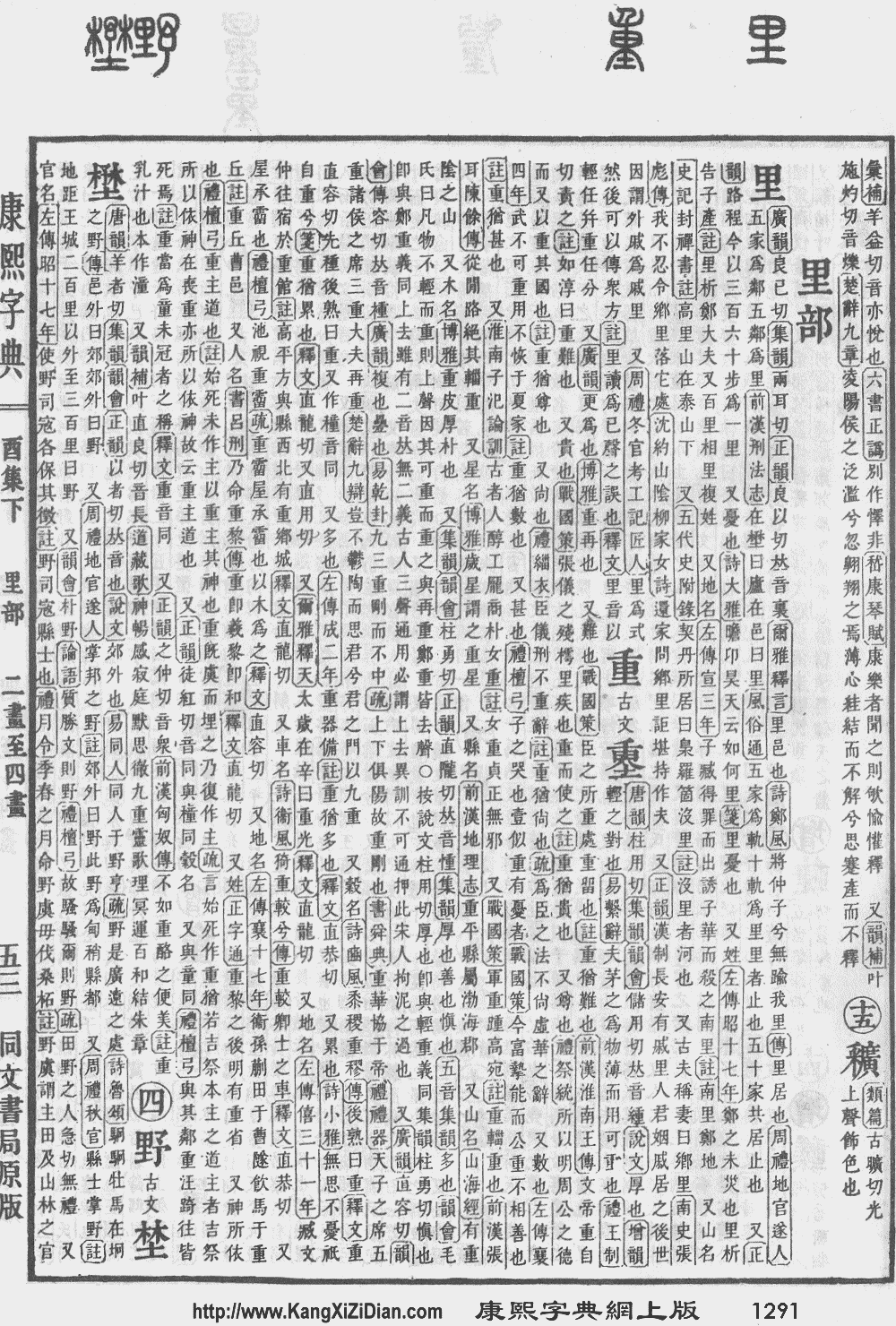
- KangXi: page 1291, character 3
- Dai Kanwa Jiten: character 40132
- Dae Jaweon: page 1791, character 7
- Hanyu Da Zidian (first edition): volume 6, page 3680, character 2
- Unihan data for U+91CD
Chinese
| simp. and trad. |
重 | |
|---|---|---|
| alternative forms | 𡍴 ancient 𡍺 ancient 𨤣 | |
Glyph origin
| Historical forms of the character 重 | ||||
|---|---|---|---|---|
| Shang | Western Zhou | Warring States | Shuowen Jiezi (compiled in Han) | Liushutong (compiled in Ming) |
| Oracle bone script | Bronze inscriptions | Chu slip and silk script | Small seal script | Transcribed ancient scripts |
 |
 |
 |
 |
 |
| Old Chinese | |
|---|---|
| 撞 | *rdoːŋ, *rdoːŋs |
| 幢 | *rdoːŋ, *rdoːŋs |
| 橦 | *rdoːŋ, *doːŋ, *tjoŋ |
| 噇 | *rdoːŋ |
| 𩪘 | *rdoːŋ |
| 艟 | *rdoːŋs, *tʰjoŋ |
| 憧 | *rdoːŋs, *tʰjoŋ |
| 畽 | *tʰoːnʔ, *tʰuːnʔ |
| 董 | *toːŋʔ |
| 蕫 | *toːŋʔ, *doːŋ |
| 箽 | *toːŋʔ |
| 懂 | *toːŋʔ |
| 湩 | *toːŋs, *tuːŋʔ, *toŋs |
| 曈 | *tʰoːŋ, *tʰoːŋʔ, *doːŋ |
| 童 | *doːŋ |
| 僮 | *doːŋ |
| 瞳 | *doːŋ |
| 罿 | *doːŋ, *tʰjoŋ |
| 犝 | *doːŋ |
| 潼 | *doːŋ, *tʰjoŋ |
| 穜 | *doːŋ, *doŋ |
| 動 | *doːŋʔ |
| 慟 | *doːŋs |
| 堹 | *toŋs |
| 諥 | *toŋs |
| 蹱 | *tʰoŋ, *tʰoŋs, *tjoŋ |
| 重 | *doŋ, *doŋʔ, *doŋs |
| 緟 | *doŋ, *doŋs |
| 蝩 | *doŋ |
| 褈 | *doŋ, *tʰjoŋ |
| 鐘 | *tjoŋ, *tjoŋ |
| 鍾 | *tjoŋ |
| 籦 | *tjoŋ |
| 種 | *tjoŋʔ, *tjoŋs |
| 腫 | *tjoŋʔ |
| 踵 | *tjoŋʔ |
| 歱 | *tjoŋʔ |
| 喠 | *tjoŋʔ, *tʰjoŋʔ |
| 偅 | *tjoŋs |
| 衝 | *tʰjoŋ |
| 揰 | *tʰjoŋs |
| 尰 | *djoŋʔ |
Phono-semantic compound (形聲, OC *doŋ, *doŋʔ, *doŋs) and ideogrammic compound (會意) : semantic 人 (“man”) + phonetic 東 (OC *toːŋ, “bag”) – a man carrying a bag. A glyph 土 (“earth”) was later added to show that the bag-carrying man is standing on the ground. From this composition is the current form.
Etymology
Schuessler (2007) notes that the etymology is uncertain and compares the word to Burmese စုံ (cum, “to be sufficient; pair”), which STEDT puts under Proto-Sino-Tibetan *dzum ~ tsum (“pair”). But the more likely cognate could be Burmese တောင့် (taung., “to be stout, sufficient, strong, heavy; to be stiff”).
Pronunciation 3 is the exoactive derivation of pronunciation 1.
Pronunciation 1
Synonyms
| Variety | Location | Words |
|---|---|---|
| Classical Chinese | 重 | |
| Formal (Written Standard Chinese) | 重 | |
| Mandarin | Beijing | 沉, 重 |
| Taiwan | 重 | |
| Jinan | 沉, 重 | |
| Xi'an | 沉, 重 | |
| Wuhan | 重 | |
| Chengdu | 重 | |
| Guilin | 重 | |
| Yangzhou | 重 | |
| Hefei | 重 | |
| Cantonese | Guangzhou | 重 |
| Hong Kong | 重 | |
| Yangjiang | 重 | |
| Gan | Nanchang | 重 |
| Hakka | Meixian | 重 |
| Jin | Taiyuan | 重, 沉 |
| Min Bei | Jian'ou | 重 |
| Min Dong | Fuzhou | 重 |
| Min Nan | Xiamen | 重 |
| Quanzhou | 重 | |
| Zhangzhou | 重 | |
| Chaozhou | 重 | |
| Wu | Suzhou | 重 |
| Wenzhou | 重 | |
| Xiang | Changsha | 重 |
| Shuangfeng | 重 | |
Compounds
|
|
|
Pronunciation 2
Definitions
重
- weight
- weighty; important
- 重任 ― zhòngrèn ― important task
- grave; serious
- solemn
- prudent
- to respect; to attach importance to
- 重義輕利/重义轻利 ― zhòngyìqīnglì ― to value righteousness and care little for material gain
- 俗尚廉恥,人性和善少言,重佛法,域中並無宰殺。 [Classical Chinese, trad.]
- From: Tang Dynasty, Fan Chuo, Manshu, chapter 10, part 2
- Súshàng liánchǐ, rénxìng héshàn shǎo yán, zhòng fófǎ, yù zhōng bìng wú zǎishā. [Pinyin]
- Their traditional customs are integrity and decency; the people are good-natured and do not chatter idly, seriously respecting Buddhist law, and nothing is killed in the region.
俗尚廉耻,人性和善少言,重佛法,域中并无宰杀。 [Classical Chinese, simp.]
- (Cantonese) still
- alt. forms: 仲
- 被單正話洗完番嚟都重濕濕地 [Cantonese, trad.]
- From: 1841, Elijah Coleman Bridgman, A Chinese Chrestomathy in the Canton Dialect, page 157
- pei5 daan1 zing3 waa6 sai2 jyun4 faan1 lai4 dou1 zung6 sap1 sap1 dei6 [Jyutping]
- [T]he sheets have just now come back from being washed, and are a little damp.
被单正话洗完番嚟都重湿湿地 [Cantonese, simp.]- 耶穌知到,就對佢哋話,做乜𢬿冇餅嚟議論呢,你哋重唔知到,唔明白咩,心中都重咁硬咩。 [Cantonese, trad.]
- From: 1899, 馬可福音:中西字 [The Gospel according to St. Mark in English and Cantonese], page 36
- je4 sou1 zi1 dou3, zau6 deoi3 keoi5 dei6 waa6, zou6 mat1 kaai5 mou5 beng2 lai4 ji5 leon6 ne1, nei5 dei6 zung6 m4 zi1 dou3, m4 ming4 baak6 me1, sam1 zung1 dou1 zung6 gam3 ngaang6 me1. [Jyutping]
- And when Jesus knew it, he said unto them, Why reason ye, becayse ye have no bread? perceive ye not yet, neither understand? have ye your heart yet hardened?
耶稣知到,就对佢哋话,做乜𢬿冇饼嚟议论呢,你哋重唔知到,唔明白咩,心中都重咁硬咩。 [Cantonese, simp.]
- (Cantonese) even more
- alt. forms: 仲
- 女徒對心慈話、到嘵呢處、致知到我丈夫所遇著嘅、比較我哋重苦、因佢係獨自己喺呢處、我哋有幾個人同伴。 [Cantonese, trad.]
- From: 1870, George H. Piercy, 《續天路歷程土話》, volume 4, page 6
- neoi5 tou4 deoi3 sam1 ci4 waa6, dou3 hiu1 ni1 cyu3, zi3 zi1 dou3 ngo5 zoeng6 fu1 so2 jyu6 zoek3 ge3, bei2 gaau3 ngo5 dei6 zung6 fu2, jan1 keoi5 hai6 duk6 zi6 gei2 hai2 ni1 cyu3, ngo5 dei6 jau5 gei2 go3 jan4 tung4 bun6. [Jyutping]
- (please add an English translation of this example)
女徒对心慈话、到哓呢处、致知到我丈夫所遇著嘅、比较我哋重苦、因佢系独自己喺呢处、我哋有几个人同伴。 [Cantonese, simp.]

Synonyms
Pronunciation 3
Definitions
重
Compounds
Japanese
Readings
From Middle Chinese 重 (MC ɖɨoŋX); compare Mandarin 重 (zhòng):
From Middle Chinese 重 (MC ɖɨoŋ); compare Mandarin 重 (chóng):
From native Japanese roots:
- Kun: え (e, 重, Jōyō)←へ (fe, 重, historical); かさなる (kasanaru, 重なる, Jōyō); かさねる (kasaneru, 重ねる, Jōyō); おも (omo, 重); おもい (omoi, 重い, Jōyō); おもなう (omonau, 重なう); おもり (omori, 重り); おもんずる (omonzuru, 重んずる); ほとんど (hotondo, 重んど)
- Nanori: あつ (atsu); あつし (atsushi); いかし (ikashi); え (e); おもし (omoshi); かさぬ (kasanu); かず (kazu); かたし (katashi); さね (sane); しげ (shige); しげし (shigeshi); しげる (shigeru); のぶ (nobu); ふさ (fusa)
Compounds
- 重油 (jūyu, “fuel oil”)
- 重量 (jūryō, “weight”)
- 重力 (jūryoku, “gravity, force of gravity”)
- 重圧 (jūatsu, “pressure”)
- 重心 (jūshin, “center of gravity”)
- 重傷 (jūshō, “heavy wound”)
- 重態 (jūtai, “serious condition”)
- 重税 (jūzei, “heavy taxation”)
- 重要 (jūyō, “important, momentous”)
- 重点 (jūten, “important point, emphasis”)
- 重大 (jūdai, “serious, important”)
- 重視 (jūshi, “importance, stress”)
- 重任 (jūnin, “heavy responsibility, reappointment”)
- 重宝 (chōhō, “convenience, usefulness”)
- 重文 (jūbun, “compound sentence”)
- 重用 (jūyō), 重用 (chōyō, “appointing to a responsible post”)
- 重箱 (jūbako, “nest of boxes”)
- 重奏 (jūsō, “duet”)
- 重合 (jūgō, “polymerization”)
- 重積 (jūseki, “piling up”)
- 重々 (jūjū), 重重 (jūjū, “repeatedly, extremely”)
- 重複 (chōfuku), 重複 (jūfuku, “duplication, repetition”)
- 重盗 (jūtō, “double seal”)
- 重版 (jūhan, “second printing”)
- 重婚 (jūkon, “bigamy”)
- 重荷 (omoni, “heavy load”)
- 重い (omoi, “heavy, serious”)
- 重さ (omosa, “weight”)
- 重み (omomi, “weight, importance”)
- 重り (omori, “weight, plumb”)
- 重ね (kasane, “pile, lapping over”)
- 過重 (kajū, “overweight”)
- 体重 (taijū, “body weight”)
- 比重 (hijū, “specific gravity, relative importance”)
- 荷重 (kajū, “load”)
- 厳重 (genjū, “strict, rigor”)
- 貴重 (kichō, “precious, valuable”)
- 尊重 (sonchō, “respect, esteem”)
- 偏重 (henchō, “preponderance, overestimation”)
- 珍重 (chinchō, “prize, value highly”)
- 慎重 (shinchō, “prudence, discretion”)
- 荘重 (sōchō, “solemn, grave”)
- 多重 (tajū, “multiple, multiplex”)
- 三重 (sanjū, “threefold, triple”)
- 幾重 (ikue), 幾重 (ikujū, “manyfold”)
- 二重 (futae), 二重 (nijū, “twofold”)
- 重金属 (jūkinzoku, “heavy metal”)
- 重工業 (jūkōgyō, “heavy industry”)
- 重電機 (jūdenki, “heavy electric apparatus”)
- 重騎兵 (jūkihei, “heavy cavalry”)
- 重労働 (jūrōdō, “heavy labor”)
- 重たい (omotai, “heavy”)
- 重ねる (kasaneru, “pile up, repeat”)
- 重ねて (kasanete, “repeatedly, again”)
- 重なる (kasanaru, “be piled up, fall on”)
- 重なり (kasanari, “pile, overlapping”)
- 重商主義 (jūshōshugi, “mercantilism”)
- 重畳たる (chōjōtaru, “piled up, excellent”)
- 重苦しい (omokurushii, “heavy, oppressed”)
- 八重咲き (yaezaki, “double blossom”)
- 積み重ねる (tsumikasaneru, “pile up”)
- 折り重なる (orikasanaru, “lie on top of one another”)
- 重要文化財 (jūyō bunkazai, “important cultural property”)
- 腰が重い (koshiga omoi, “be slow to act”)
- 重い罪 (omoi tsumi, “serious crime”)
- 重い任務 (omoi ninmu, “important task”)
- 糸に重りを付ける (ito ni omori o tsukeru, “weight a line”)
- 不幸が重なる (fukō ga kasanaru, “have a series of misfortunes”)
Derived terms
- 隔てる (hedateru)
See also
- 重 (e)
Etymology 2
/-pe/ → /-ɸe/ → /-we/ → /-e/. Cognate with 重 (he, “division”). The divergent phonological development is due to the non-null environment caused by being suffixed to the previous morpheme.
Alternative forms
See also
- 重な
Korean
Etymology 1
(This etymology is missing or incomplete. Please add to it, or discuss it at the Etymology scriptorium.)
Vietnamese
Han character
重: Hán Nôm readings: trọng, chồng, chuộng, trộng, trụng, trùng, chõng, trửng
- This term needs a translation to English. Please help out and add a translation, then remove the text
{{rfdef}}.