貴
| ||||||||
Translingual
Han character
貴 (Kangxi radical 154, 貝+5, 12 strokes, cangjie input 中一月山金 (LMBUC), four-corner 50806, composition ⿱𠀐貝)
References
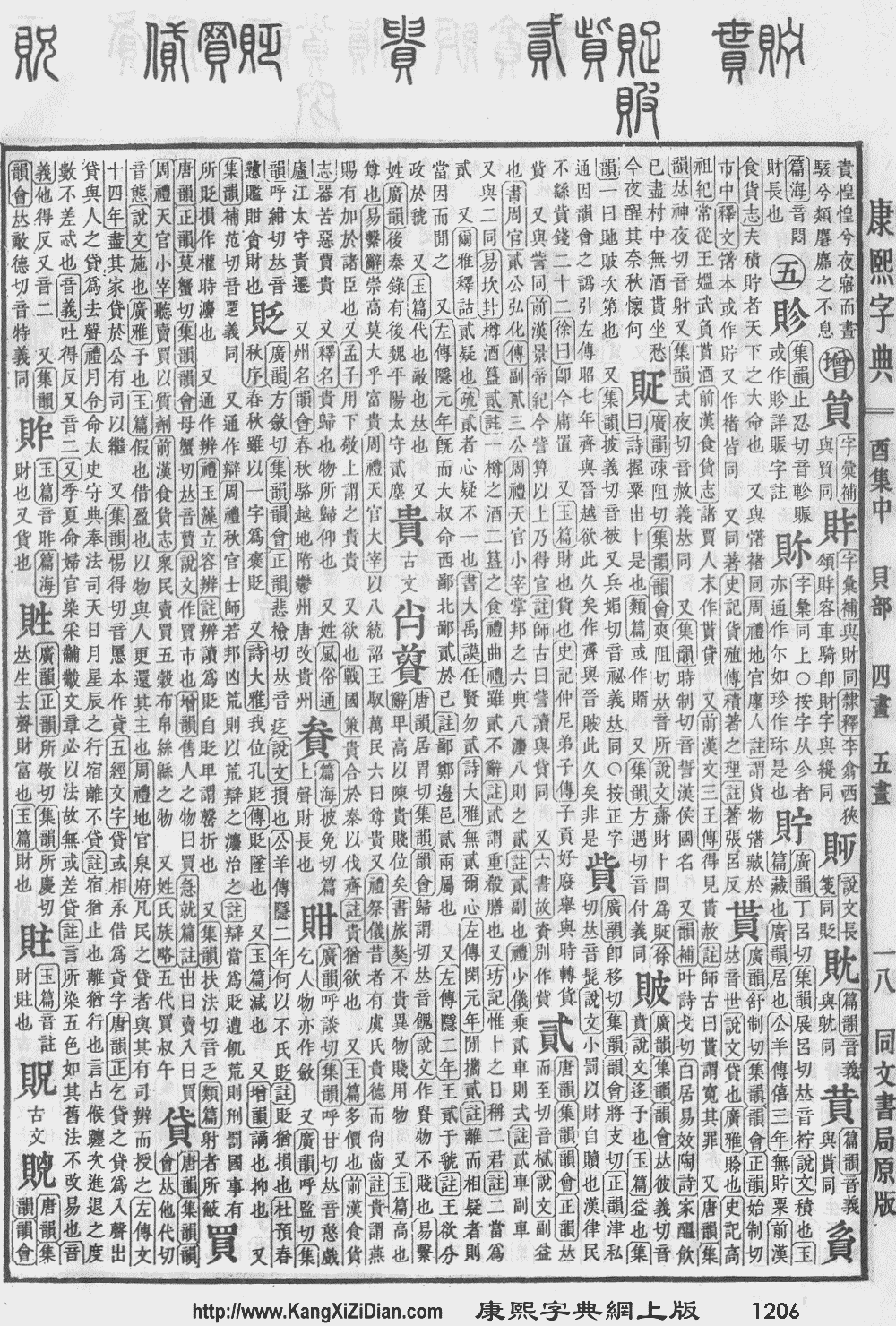
- KangXi: page 1206, character 15
- Dai Kanwa Jiten: character 36704
- Dae Jaweon: page 1669, character 5
- Hanyu Da Zidian (first edition): volume 6, page 3632, character 9
- Unihan data for U+8CB4
Chinese
| trad. | 貴 | |
|---|---|---|
| simp. | 贵 | |
| alternative forms | 䝿 𧷈 𧸋 𡭙 | |
Glyph origin
| Old Chinese | |
|---|---|
| 藬 | *l'uːl |
| 僓 | *l̥ʰuːlʔ, *ɡluːds |
| 頹 | *l'uːl |
| 穨 | *l'uːl |
| 蘈 | *l'uːl |
| 隤 | *l'uːl |
| 墤 | *l'uːl, *kʰruːds |
| 尵 | *l'uːl, *r'uːl |
| 蹪 | *l'uːl |
| 瀢 | *l'uːlʔ, *lulʔ |
| 鞼 | *kluːl, *ɡruls |
| 膭 | *kluːl, *ɡluːls |
| 憒 | *kluːds |
| 靧 | *ɡluːds |
| 潰 | *ɡluːls |
| 繢 | *ɡluːds |
| 嬇 | *ɡluːds, *kʰruːds |
| 殨 | *ɡluːds |
| 闠 | *ɡluːds |
| 簣 | *kʰruːds, *ɡruds |
| 嘳 | *kʰruːds, *kʰruds |
| 蕢 | *kʰruːds, *ɡruds |
| 聵 | *ŋɡruːds |
| 樻 | *kʰruds, *ɡruds |
| 䙡 | *kʰruds, *kʰluds |
| 匱 | *ɡruds |
| 臾 | *ɡruds, *lo |
| 饋 | *ɡruls |
| 櫃 | *ɡruds |
| 遺 | *lul, *luls |
| 壝 | *lul, *lulʔ |
| 瞶 | *luls, *kluls |
| 貴 | *kluds |
Simplified from 䝿 (guì) (臾 → 𠀐 (zhōng)). Phono-semantic compound (形聲, OC *kluds) : phonetic 臾 (OC *ɡruds, *lo) + semantic 貝 (“money cowrie”).
Etymology
From Sino-Tibetan; compare Tibetan གུས (gus, “respect, reverence, devotion”) (Schuessler, 2007; STEDT).
Pronunciation
Definitions
貴
- expensive; costly
- precious; valuable
- superior; noble
- 富與貴是人之所欲也,不以其道得之,不處也;貧與賤是人之所惡也,不以其道得之,不去也。 [Classical Chinese, trad.]
- From: The Analects of Confucius, c. 475 – 221 BCE, translated based on James Legge's version
- Fù yǔ guì shì rén zhī suǒ yù yě, bù yǐ qí dào dé zhī, bù chù yě; pín yǔ jiàn shì rén zhī suǒ è yě, bù yǐ qí dào dé zhī, bù qù yě. [Pinyin]
- Riches and honors are what men desire. If it cannot be obtained in the proper way, they should not be held. Poverty and meanness are what men dislike. If it cannot be avoided in the proper way, they should not be avoided.
富与贵是人之所欲也,不以其道得之,不处也;贫与贱是人之所恶也,不以其道得之,不去也。 [Classical Chinese, simp.]
- to regard as valuable
- (humble) your (to a deity, person or establishment)
- Short for 貴州/贵州 (Guìzhōu).
- a surname
Synonyms
| Variety | Location | Words |
|---|---|---|
| Classical Chinese | 貴 | |
| Formal (Written Standard Chinese) | 貴, 昂貴, 高昂 | |
| Mandarin | Beijing | 貴 |
| Taiwan | 貴 | |
| Jinan | 貴 | |
| Xi'an | 貴 | |
| Wuhan | 貴 | |
| Chengdu | 貴 | |
| Guilin | 貴 | |
| Yangzhou | 貴 | |
| Hefei | 貴 | |
| Malaysia | 貴 | |
| Singapore | 貴 | |
| Cantonese | Guangzhou | 貴 |
| Hong Kong | 貴 | |
| Hong Kong (San Tin Weitou) | 貴 | |
| Hong Kong (Ting Kok) | 貴 | |
| Hong Kong (Tung Ping Chau) | 貴 | |
| Yangjiang | 貴 | |
| Singapore (Guangfu) | 貴 | |
| Gan | Nanchang | 貴 |
| Hakka | Meixian | 貴 |
| Miaoli (N. Sixian) | 貴 | |
| Pingtung (Neipu; S. Sixian) | 貴 | |
| Hsinchu County (Zhudong; Hailu) | 貴 | |
| Taichung (Dongshi; Dabu) | 貴 | |
| Hsinchu County (Qionglin; Raoping) | 貴 | |
| Yunlin (Lunbei; Zhao'an) | 貴 | |
| Hong Kong | 貴 | |
| Jin | Taiyuan | 貴 |
| Min Bei | Jian'ou | 貴 |
| Min Dong | Fuzhou | 貴 |
| Min Nan | Xiamen | 貴 |
| Singapore (Hokkien) | 貴 | |
| Chaozhou | 貴 | |
| Wu | Suzhou | 貴 |
| Wenzhou | 貴 | |
| Xiang | Changsha | 貴 |
| Shuangfeng | 貴 | |
Usage notes
In Hong Kong and Taiwan, a space is often left before this word when it is used as a humble term of "your" to show respect when writing formal letters, and this practice is known as 抬頭/抬头 (táitóu). This practice, however, is not common in Mainland China.
Compounds
|
|
|
References
- “貴”, in 漢語多功能字庫 (Multi-function Chinese Character Database), 香港中文大學 (the Chinese University of Hong Kong), 2014–
- “Entry #9061”, in 臺灣閩南語常用詞辭典 [Dictionary of Frequently-Used Taiwan Minnan] (in Chinese and Min Nan), Ministry of Education, R.O.C., 2011.
Japanese
Kanji
Readings
- Go-on: き (ki, Jōyō)←き (ki, historical)←くゐ (kwi, ancient)
- Kan-on: き (ki, Jōyō)←き (ki, historical)←くゐ (kwi, ancient)
- Kun: たかい (takai, 貴い); たっとい (tattoi, 貴い, Jōyō)←たつとい (tatutoi, 貴い, historical); とうとい (tōtoi, 貴い, Jōyō)←たふとい (tafutoi, 貴い, historical); たっとぶ (tattobu, 貴ぶ, Jōyō)←たつとぶ (tatutobu, 貴ぶ, historical); とうとぶ (tōtobu, 貴ぶ, Jōyō)←たふとぶ (tafutobu, 貴ぶ, historical)
- Nanori: きよ (kiyo); ぎ (gi); たか (taka); たかし (takashi); よし (yoshi)
Compounds
Etymology 1
| Kanji in this term |
|---|
| 貴 |
| き Grade: 6 |
| goon |
From Middle Chinese 貴 (MC kʉiH, literally “precious, noble, superior”).
Pronunciation
- IPA(key): [kʲi]
Prefix
貴 • (ki-)
- (archaic) added to nouns related to people to indicate superiority
- 貴公子、貴婦人、貴賓
- kikōshi, kifujin, kihin
- [young] nobleman, noblewoman, superior guest
- 貴公子、貴婦人、貴賓
- (archaic) added to nouns to indicate respect and possession: your
- 貴店
- kiten
- your [honorable] store
- 貴店
Derived terms
- 貴様 (kisama): you (derogatory: the original “superior” meaning degraded over time, becoming ironic, and then insulting)
Usage notes
This suffix meaning appears from roughly the Edo period.
Derived terms
Etymology 2
| Kanji in this term |
|---|
| 貴 |
| あて Grade: 6 |
| kun’yomi |
Unknown. Possibly cognate with 当て (ate, “aim; expectation, hope”), the 連用形 (ren'yōkei, “continuative or stem form”) of verb 当てる (ateru, “to face one thing towards another; to make something hit a target”).
Pronunciation
- IPA(key): [a̠te̞]
Inflection
| Stem forms | ||||
|---|---|---|---|---|
| Irrealis (未然形) | 貴なら | あてなら | atenara | |
| Continuative (連用形) | 貴に[1] 貴なり[2] | あてに あてなり | ateni atenari | |
| Terminal (終止形) | 貴なり | あてなり | atenari | |
| Attributive (連体形) | 貴なる | あてなる | atenaru | |
| Realis (已然形) | 貴なれ | あてなれ | atenare | |
| Imperative (命令形) | 貴なれ | あてなれ | atenare | |
| Key constructions | ||||
| Negative | 貴ならず | あてならず | atenarazu | |
| Contrasting conjunction | 貴なれど | あてなれど | atenaredo | |
| Causal conjunction | 貴なれば | あてなれば | atenareba | |
| Conditional conjunction | 貴ならば | あてならば | atenaraba | |
| Past tense (firsthand knowledge) | 貴なりき | あてなりき | atenariki | |
| Past tense (secondhand knowledge) | 貴なりけり | あてなりけり | atenarikeri | |
| Adverbial | 貴に | あてに | ateni | |
| [1]Without auxiliary verb. [2]With auxiliary verb. | ||||
Noun
貴 • (ate)
- (archaic) one's own father (by extension of the “noble” meaning)
- 1028-1107: 栄花物語 (Eiga Monogatari, “Tale of Splendor”)
- 貴は麿をば恋しとは思ひ給はぬか
- Ate wa maro oba koishi to wa omohitamahanu ka
- Doesn't father think I'm his darling?
- 貴は麿をば恋しとは思ひ給はぬか
- 1028-1107: 栄花物語 (Eiga Monogatari, “Tale of Splendor”)
Derived terms
Etymology 3
| Kanji in this term |
|---|
| 貴 |
| むち Grade: 6 |
| kun’yomi |
Possibly a compound of 身 (mu, “body”) + 霊 (chi, “spirit, essence, soul”).[1] Alternatively, may be an alteration of 睦 (mutsu, “friendly, harmonious”, affix not used in isolation),[1] probably caused by fusion with the Old Japanese emphatic nominal particle い (i) in a manner similar to the alteration between kamu (combining form) and kami (standalone form) for 神 (“god, spirit”), or kutsu (combining form) and kuchi (standalone form) for 口 (“mouth”).
Pronunciation
- IPA(key): [mɯ̟ᵝt͡ɕi]
Noun
貴 • (muchi)
Derived terms
- 汝 (namuchi)
Etymology 4
Used as ateji in various names.
Proper noun
貴 • (Ateshi)
- a male given name
Proper noun
貴 • (Taka)
- a male given name
- a surname
Proper noun
貴 • (Takashi)
- a male given name
Proper noun
貴 • (Tadashi)
- a male given name
Proper noun
貴 • (Motomu)
- a male given name
Proper noun
貴 • (Kisaki)
- a surname
References
- 1988, 国語大辞典(新装版) (Kokugo Dai Jiten, Revised Edition) (in Japanese), Tōkyō: Shogakukan