尋
See also: 寻
| ||||||||
Translingual
Han character
尋 (Kangxi radical 41, 寸+9, 12 strokes, cangjie input 尸一一口戈 (SMMRI), four-corner 17346, composition ⿳𫜹⿰工口寸(GJV) or ⿳⺕⿰工口寸(HTK))
Derived characters
References
- KangXi: page 295, character 12
- Dai Kanwa Jiten: character 7447
- Dae Jaweon: page 586, character 2
- Hanyu Da Zidian (first edition): volume 1, page 510, character 1
- Unihan data for U+5C0B
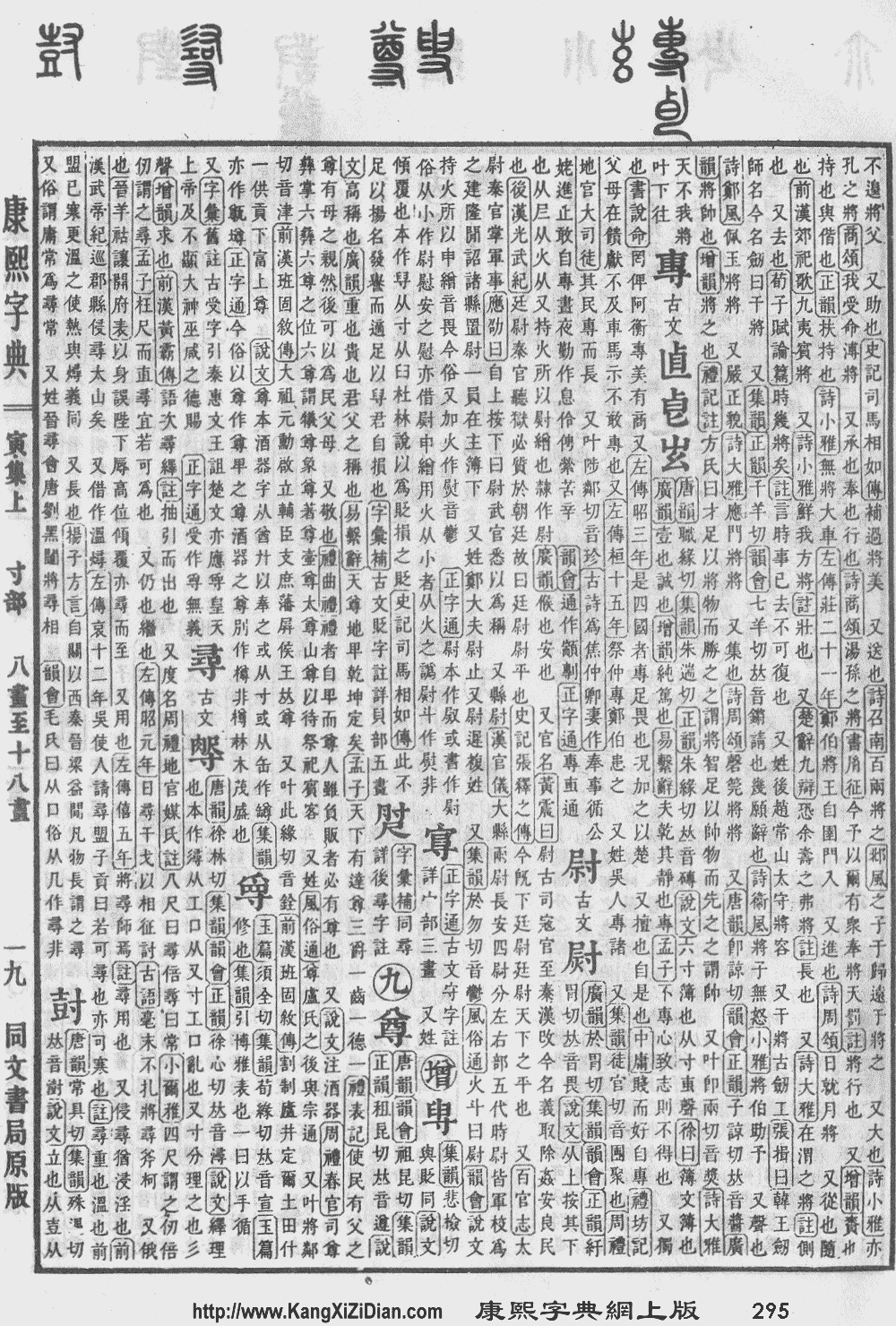
Chinese
Glyph origin
| Historical forms of the character 尋 | ||
|---|---|---|
| Shang | Shuowen Jiezi (compiled in Han) | Liushutong (compiled in Ming) |
| Oracle bone script | Small seal script | Transcribed ancient scripts |
 |
 |
 |
Characters in the same phonetic series (尋) (Zhengzhang, 2003)
Ideogrammic compound (會意) : 工 (“work”) + 口 (“mouth, talk”) + 又 (“hand”) + 寸 (“hand”) – to seek out, with hands and mouth (asking).
Note that top hand is not in 又 shape, but rather resembles 彐; this is an earlier form of hand (fingers); see etymology of 又.
Etymology 1
| trad. | 尋 | |
|---|---|---|
| simp. | 寻 | |
- unit of length; arm span
- From Proto-Sino-Tibetan *s-la(ː)m (“armspan; fathom; cord”) (STEDT). Cognate with Mizo hlam (“measurement (armspan)”), Burmese လှမ်း (hlam:, “to reach out”).
- to seek; to search
- Attested since the Eastern Han dynasty. (This etymology is missing or incomplete. Please add to it, or discuss it at the Etymology scriptorium.)
Pronunciation
Definitions
尋
- to seek; to search; to look for
- 喂,儂尋啥人? [Shanghainese, trad.]
- [ɯe̞⁵³ nʊŋ²³ ʑ̥ɪɲ²³ sa̱³³ n̠ʲɪɲ⁴⁴] [IPA]
- Hello, who are you looking for?
喂,侬寻啥人? [Shanghainese, simp.]
- 丞相祠堂何處尋,錦官城外柏森森。 [Classical Chinese, trad.]
- From: 760 CE, 杜甫 (Du Fu), 蜀相 (Shu's minister); translated by Stephen Owen
- Chéngxiàng cítáng héchù xún, Jǐnguānchéng wài bǎi sēnsēn. [Pinyin]
- The shrine hall to the Minister, where can it be found? —outside the walls of Brocade City, where the cypress tree stands dense.
丞相祠堂何处寻,锦官城外柏森森。 [Classical Chinese, simp.]
- an ancient unit of length equivalent to eight chis; arm span
- 徂來之松,新甫之柏。是斷是度,是尋是尺。 [Pre-Classical Chinese, trad.]
- From: The Classic of Poetry, c. 11th – 7th centuries BCE, translated based on James Legge's version
- Cúlái zhī sōng, Xīnfǔ zhī bǎi. Shì duàn shì dù, shì xún shì chǐ. [Pinyin]
- The pines of Cu-lai, and the cypresses of Xin-fu, were cut down and measured, with the cubit line and the eight cubits line.
徂来之松,新甫之柏。是断是度,是寻是尺。 [Pre-Classical Chinese, simp.]
- (literary) soon; before long
- 南陽劉子驥,高尚士也,聞之,欣然親往。未果,尋病終。 [Classical Chinese, trad.]
- From: The Peach Blossom Spring (桃花源記), by Tao Yuanming, 421 (Wiktionary translation)
- Nányáng Liú Zǐjì, gāoshàng shì yě, wén zhī, xīnrán qīn wǎng. Wèiguǒ, xún bìng zhōng. [Pinyin]
- Liu Ziji of Nanyang was a noble scholar who heard of this, and joyously set out for it, but to no avail; he died of illness shortly afterwards.
南阳刘子骥,高尚士也,闻之,欣然亲往。未果,寻病终。 [Classical Chinese, simp.]
- a surname
Synonyms
Dialectal synonyms of 找 (“to look for, to seek, to search for”) [map]
Compounds
Derived terms from 尋
|
|
|
Pronunciation
Japanese
| Shinjitai | 尋 | |
| Kyūjitai [1] |
尋󠄁 尋+ 󠄁?(Adobe-Japan1) |
 |
| 尋󠄃 尋+ 󠄃?(Hanyo-Denshi) (Moji_Joho) | ||
| The displayed kanji may be different from the image due to your environment. See here for details. | ||
Readings
- Go-on: じん (jin, Jōyō)←じん (zin, historical)←じむ (zimu, ancient)
- Kan-on: しん (shin)←しん (sin, historical)←しむ (simu, ancient)
- Kun: たずねる (tazuneru, 尋ねる, Jōyō); あたためる (atatameru, 尋める); ついで (tsuide, 尋いで); ひろ (hiro, 尋)
- Nanori: ちか (chika); つね (tsune); のり (nori); ひつ (hitsu); ひろ (hiro); ひろし (hiroshi); みつ (mitsu)
References
- “尋”, in 漢字ぺディア (Kanjipedia) (in Japanese), 日本漢字能力検定協会, 2015—2023
Korean
Hanja
尋 (eum 심 (sim))
- This term needs a translation to English. Please help out and add a translation, then remove the text
{{rfdef}}.
Vietnamese
This article is issued from Wiktionary. The text is licensed under Creative Commons - Attribution - Sharealike. Additional terms may apply for the media files.