衰
| ||||||||
Translingual
Han character
衰 (Kangxi radical 145, 衣+4, 10 strokes, cangjie input 卜田一女 (YWMV), four-corner 00732, composition ⿳亠⏛𧘇 or ⿻哀一)
Derived characters
References
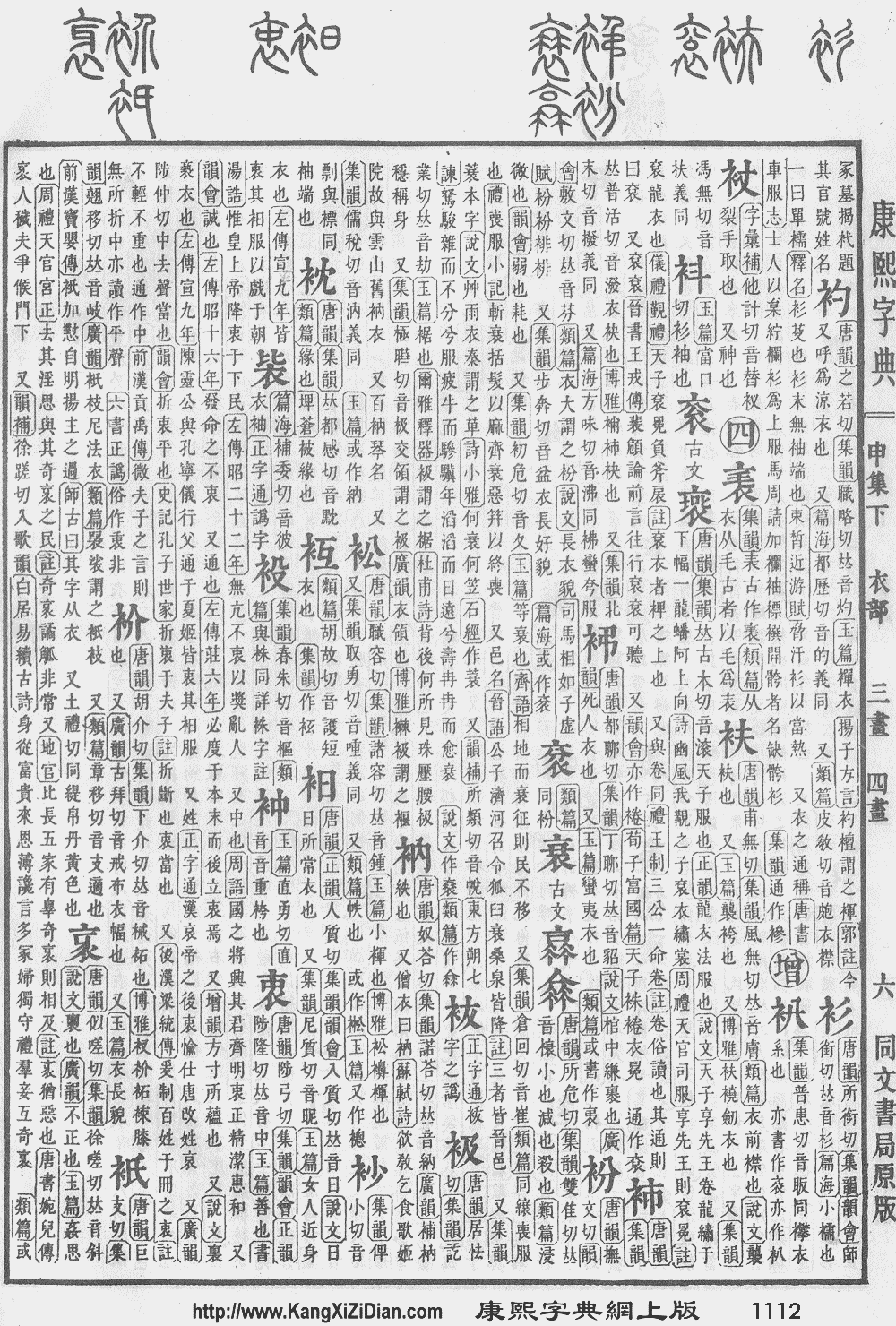
- KangXi: page 1112, character 14
- Dai Kanwa Jiten: character 34127
- Dae Jaweon: page 1577, character 21
- Hanyu Da Zidian (first edition): volume 5, page 3076, character 9
- Unihan data for U+8870
Chinese
| simp. and trad. |
衰 | |
|---|---|---|
| alternative forms | 𠆏 𠆂 𠱗 | |
Etymology 1
Compare Khmer រៀវ (riəw, “to diminish; to decrease”), Mizo zuai (“to decline (in diligence, enthusiasm, industry, etc.)”) (Schuessler, 2007).
Pronunciation
Definitions
衰
- to grow weak; to decrease in strength; to decline
- 未老先衰 ― wèilǎoxiānshuāi ― to decline in health before becoming old
- (Cantonese, Hakka, Min) to have bad luck
- (Cantonese, Hakka) bad; detestable; awful
- 咁衰㗎! [Cantonese] ― gam3 seoi1 gaa4! [Jyutping] ― That's awful!
- 咁衰都有! [Cantonese] ― gam3 seoi1 dou1 jau5! [Jyutping] ― How can it be this awful!
- 做衰嘢 [Cantonese] ― zou6 seoi1 je5 [Jyutping] ― to do bad things
- 衰人 [Cantonese] ― seoi1 jan4 [Jyutping] ― bad person
- 衰婆 [Cantonese] ― seoi1 po4-2 [Jyutping] ― bitch
- (Cantonese) to make a grave mistake
- 我衰咗啦! [Cantonese] ― ngo5 seoi1 zo2 laa1! [Jyutping] ― I've made a mistake!
- 我衰咗三年,我等緊個機會,爭返口氣。 [Cantonese, trad.]
- From: 1986, 《英雄本色》 (“A Better Tomorrow”)
- ngo5 seoi1 zo2 saam1 nin4, ngo5 dang2 gan2 go3 gei1 wui5, caang1 faan1 hau2 hei3. [Jyutping]
- I had suffered three years of bad luck, I’m waiting for my turn to get everything back. (In context: spent three years in jail)
我衰咗三年,我等紧个机会,争返口气。 [Cantonese, simp.]
- (Cantonese, transitive) to mess up (something); to be caught for (wrongdoing)
- 你衰咩呀? [Cantonese] ― nei5 seoi1 me1 aa3? [Jyutping] ― What did you do wrong?
- 我衰邊範啫?/我衰边范啫? [Cantonese] ― ngo5 seoi1 bin1 faan6 ze1? [Jyutping] ― What’s my wrongdoing/offence (often with legal implications)?
- 衰十一 [Cantonese] ― seoi1 sap6 jat1 [Jyutping] ― to get caught for sex with a minor
- 衰販毒/衰贩毒 [Cantonese] ― seoi1 faan3 duk6 [Jyutping] ― to get caught for drug trafficking
- (Cantonese) to suffer from faulty personality traits or habits, or commit minor faults with moderate to significant consequences.
Synonyms
Dialectal synonyms of 倒霉 (“unlucky; out of luck”) [map]
Dialectal synonyms of 壞 (“bad; not good”) [map]
| Variety | Location | Words |
|---|---|---|
| Classical Chinese | 惡 | |
| Formal (Written Standard Chinese) | 壞 | |
| Mandarin | Beijing | 壞, 賴 |
| Taiwan | 壞 | |
| Jinan | 壞, 孬, 賴 | |
| Xi'an | 瞎, 壞 | |
| Wuhan | 壞, 拐 | |
| Chengdu | 壞 | |
| Yangzhou | 壞 | |
| Hefei | 壞 | |
| Malaysia | 壞 | |
| Singapore | 壞 | |
| Cantonese | Guangzhou | 壞, 弊, 衰 |
| Hong Kong | 壞, 衰 | |
| Zhongshan (Shiqi) | 衰 | |
| Yangjiang | 壞 | |
| Kuala Lumpur (Guangfu) | 衰 | |
| Singapore (Guangfu) | 衰 | |
| Gan | Nanchang | 壞 |
| Hakka | Meixian | 壞 |
| Wuhua (Meilin) | 衰 | |
| Jin | Taiyuan | 賴, 壞 |
| Min Bei | Jian'ou | 壞, 獰 |
| Min Dong | Fuzhou | 呆, 否 |
| Min Nan | Xiamen | 歹, 䆀 |
| Xiamen (Tong'an) | 歹 | |
| Quanzhou | 歹 | |
| Jinjiang | 歹 | |
| Nan'an | 歹 | |
| Shishi | 歹 | |
| Zhangzhou | 䆀 | |
| Zhao'an | 䆀, 孬 | |
| Tainan | 歹 | |
| Penang (Hokkien) | 䆀, 歹 | |
| Singapore (Hokkien) | 歹 | |
| Manila (Hokkien) | 歹 | |
| Datian | 歹 | |
| Chaozhou | 孬 | |
| Shantou | 孬 | |
| Jieyang | 孬, 歹 | |
| Singapore (Teochew) | 歹, 孬 | |
| Leizhou | 㾀 | |
| Wenchang | 㾀 | |
| Haikou | 㾀 | |
| Singapore (Hainanese) | 㾀 | |
| Wu | Shanghai | 壞, 恘 |
| Suzhou | 壞, 恘 | |
| Ningbo | 歪, 推扳, 嘸做 | |
| Wenzhou | 毛 | |
| Xiang | Changsha | 壞, 拐 |
| Shuangfeng | 壞, 拐 | |
Antonyms
- (Cantonese: disagreeable): 好 (hou2)
Compounds
Derived terms from 衰
|
Etymology 2
Schuessler (2007) reconstructs the Old Chinese minimally as *k-sroi, treating it as 衰 (OC *srui) (etymology 1) with the initial *k.
Pronunciation
Etymology 3
(This etymology is missing or incomplete. Please add to it, or discuss it at the Etymology scriptorium.)
Pronunciation
Compounds
|
|
References
- “衰”, in 漢語多功能字庫 (Multi-function Chinese Character Database), 香港中文大學 (the Chinese University of Hong Kong), 2014–
- Dictionary of Chinese Character Variants (教育部異體字字典), A03712
Japanese
Kanji
衰
- This term needs a translation to English. Please help out and add a translation, then remove the text
{{rfdef}}.
Readings
Compounds
- 老衰 (rōsui)
Korean
Vietnamese
This article is issued from Wiktionary. The text is licensed under Creative Commons - Attribution - Sharealike. Additional terms may apply for the media files.