禮
| ||||||||
| ||||||||
Translingual
| Traditional | 禮 |
|---|---|
| Simplified | 礼 |
| Japanese | 礼 |
| Korean | 禮 |
Alternative forms
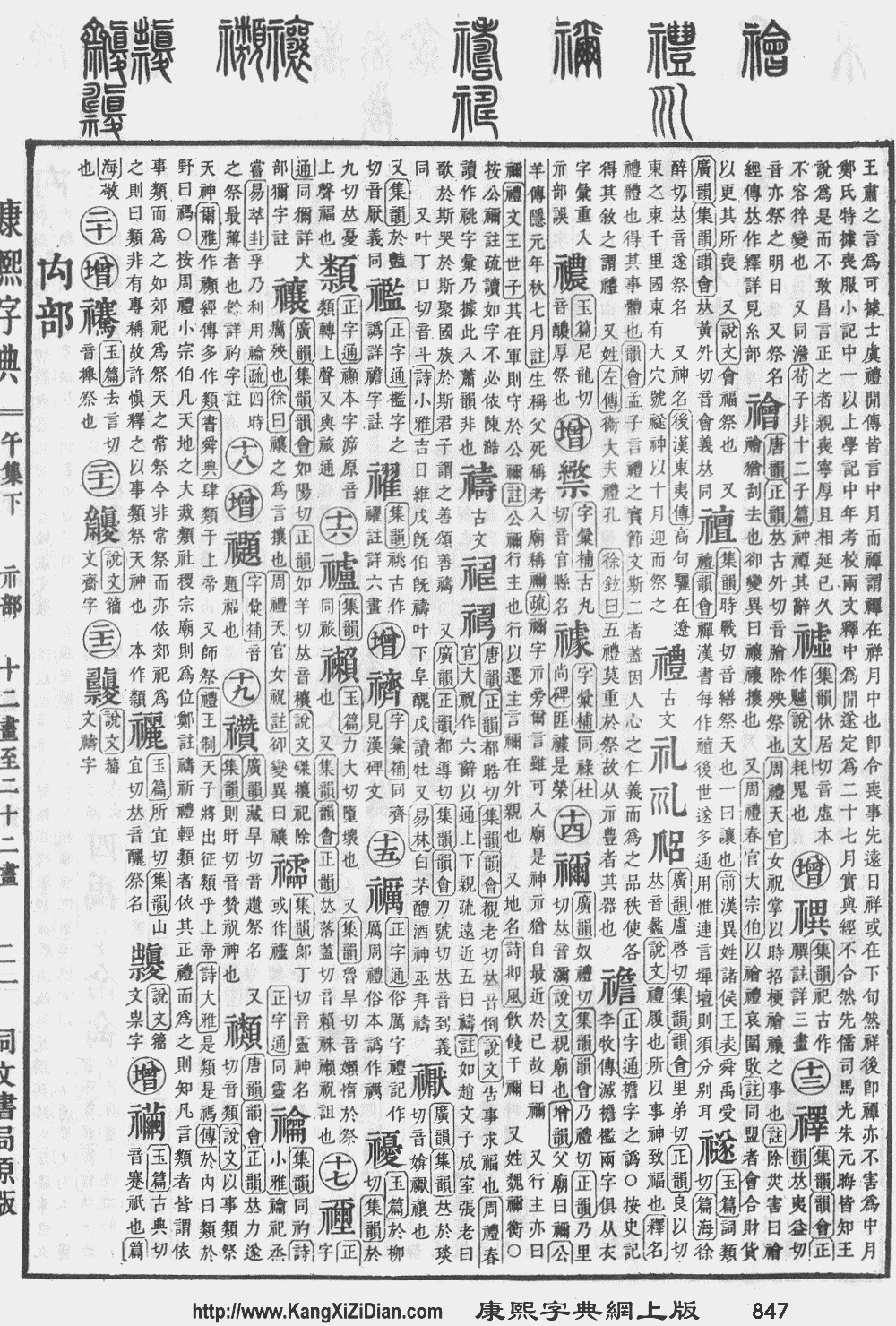
In Traditional Chinese, the component on the left of U+79AE is 礻. In Korean hanja and Japanese kyūjitai, the component on the left of U+79AE is 示 rather than 礻, which is also the historical form that appears in the Kangxi dictionary. A CJK compatibility ideograph exists at U+F9B6 to reflect the form found in the Kangxi dictionary.
Han character
禮 (Kangxi radical 113, 示+13, 18 strokes, cangjie input 戈火廿田廿 (IFTWT), four-corner 35218, composition ⿰礻豊(GHTV) or ⿰示豊(JK or U+F9B6))
Derived characters
- 𡅏, 𡓾, 𡤠, 𢹿, 𣠲, 𧕬, 𨰋
Related characters
- 礼 (Japanese shinjitai and Simplified Chinese)
References
- KangXi: page 847, character 7
- Dai Kanwa Jiten: character 24844
- Dae Jaweon: page 1268, character 9
- Hanyu Da Zidian (first edition): volume 4, page 2409, character 14
- Unihan data for U+79AE
- Unihan data for U+F9B6
Chinese
| trad. | 禮 | |
|---|---|---|
| simp. | 礼 | |
| alternative forms | ||
Glyph origin
| Historical forms of the character 禮 | |||||
|---|---|---|---|---|---|
| Shang | Western Zhou | Warring States | Shuowen Jiezi (compiled in Han) | ||
| Oracle bone script | Bronze inscriptions | Bronze inscriptions | Chu slip and silk script | Ancient script | Small seal script |
 |
 |
 |
 |
 |
 |
Phono-semantic compound (形聲, OC *riːʔ) and ideogrammic compound (會意) : semantic 礻 (“altar”) + phonetic 豊 (OC *riːʔ, “ceremony”) – performing rites at the altar.
Originally written 豊, see there for more.
Etymology
Uncertain. Schuessler (2007) proposes that this is an old areal etymon. Compare Tibetan [script needed] (zhe-sa, “respect, honor, deference”), [script needed] (rje-bo, “lord, nobleman”), [script needed] (rjed, “to honor; reverence”); Mru [script needed] (ri, “ritual”) is possibly borrowed from Austroasiatic (cf. Mon [script needed] (rèh seh, “to respect, to revere”); Thin Khmu [script needed] (rɛh, “to lift up”); both from Proto-Mon-Khmer *reh (“to raise up, to exalt”)).
Pronunciation
Definitions
禮
- ritual; rite; ceremony
- 我孔熯矣、式禮莫愆。 [Pre-Classical Chinese, trad.]
- From: The Classic of Poetry, c. 11th – 7th centuries BCE, translated based on James Legge's version
- Wǒ kǒng shàn yǐ, shì lǐ mò qiān. [Pinyin]
- We are very much exhausted, and have performed every ceremony without error.
我孔熯矣、式礼莫愆。 [Pre-Classical Chinese, simp.]- 卒廷見相如,畢禮而歸之。 [Classical Chinese, trad.]
- From: The Records of the Grand Historian, by Sima Qian, c. 91 BCE
- Zú tíng jiàn Xiāngrú, bì lǐ ér guī zhī. [Pinyin]
- In the end, (King Zhaoxiang of Qin) granted (Lin) Xiangru an audience at his court, completed the ceremonies, and sent him back.
卒廷见相如,毕礼而归之。 [Classical Chinese, simp.]
- rules of etiquette; rules of propriety
- 夫子循循然善誘人,博我以文,約我以禮。 [Classical Chinese, trad.]
- From: The Analects of Confucius, c. 475 – 221 BCE, translated based on James Legge's version
- Fūzǐ xúnxún rán shànyòu rén, bó wǒ yǐ wén, yuē wǒ yǐ lǐ. [Pinyin]
- The Master, by orderly method, skillfully leads men on. He enlarged my mind with learning, and taught me the restraints of propriety.
夫子循循然善诱人,博我以文,约我以礼。 [Classical Chinese, simp.]- 夫禮者,所以定親疏,決嫌疑,別同異,明是非也。 [Classical Chinese, trad.]
- From: The Book of Rites, c. 4th – 2nd century BCE
- Fú lǐ zhě, suǒyǐ dìng qīnshū, jué xiányí, bié tóngyì, míng shìfēi yě. [Pinyin]
- They are the rules of propriety, that furnish the means of determining (the observances towards) relatives, as near and remote; of settling points which may cause suspicion or doubt; of distinguishing where there should be agreement, and where difference; and of making clear what is right and what is wrong.
夫礼者,所以定亲疏,决嫌疑,别同异,明是非也。 [Classical Chinese, simp.]
- courtesy; etiquette; manners
- present; gift (Classifier: 份 m c)
- to treat with respect and courtesy
- 48th tetragram of the Taixuanjing; "ritual" (𝌵)
- a surname
Usage notes
Usually, a single 禮/礼 (lǐ) refers to a gift that involves more serious social interaction. For gifts between friends, 禮物/礼物 (lǐwù) is used instead.
Compounds
|
|
|
References
- “禮”, in 漢語多功能字庫 (Multi-function Chinese Character Database), 香港中文大學 (the Chinese University of Hong Kong), 2014–
Korean
Etymology
From Middle Chinese 禮 (MC leiX).
| Historical readings |
|---|
|
Pronunciation
- (SK Standard/Seoul) IPA(key): [ɾje̞] ~ [je̞]
- Phonetic hangul: [례/예]
Compounds
- 무례 (無禮, murye, “rudeness”)
- 예절 (禮節, yejeol, “manners, etiquette”)
- 예식 (禮式, yesik, “ceremony”)
- 예의 (禮儀, yeui, “manners, etiquette”)
- 혼례 (婚禮, hollye, “wedding”)
- 예배 (禮拜, yebae, “worship”)
- 결례 (缺禮, gyeollye, “discourtesy”)
- 다례 (茶禮, darye, “tea ceremony”)
- 사례 (謝禮, sarye, “return, reward”)
- 답례 (答禮, damnye, “return, reward”)
- 경례 (敬禮, gyeongnye, “salute”)
- 세례 (洗禮, serye, “baptism”)
- 장례 (葬禮, jangnye, “funeral”)
Vietnamese
| Hán tự in this term |
|---|
| 禮 |
Han character
禮: Hán Việt readings: lễ (
禮: Nôm readings: lễ[1][2][4], lạy[3][5], lẻ[1][3][5][4], lẫy[2][3][5][4], rẽ[2][3], rẩy[2][5], lẩy[3][5], lãi[3][4], lể[5][4], lởi[3], lỡi[3], lấy[3], lảy[4], rẻ[4]
References
- Nguyễn (2014).
- Nguyễn et al. (2009).
- Trần (2004).
- Taberd & Pigneau de Béhaine (1838).
- Hồ (1976).