飛
See also: 飞
| ||||||||
| ||||||||
Translingual
| Stroke order (Chinese) | |||
|---|---|---|---|
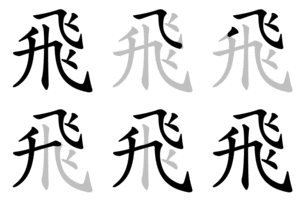 | |||
| Stroke order (Japan) | |||
|---|---|---|---|
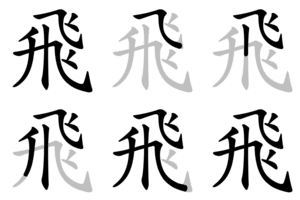 | |||
Han character
飛 (Kangxi radical 183, 飛+0, 9 strokes, cangjie input 弓人竹廿人 (NOHTO), four-corner 12413, composition ⿻𠃧⿰⿱丿丿丨)
- Kangxi radical #183, ⾶.
Derived characters
Related characters
References
- KangXi: page 1415, character 14
- Dai Kanwa Jiten: character 44000
- Dae Jaweon: page 1938, character 1
- Hanyu Da Zidian (first edition): volume 7, page 4513, character 1
- Unihan data for U+98DB

Chinese
| trad. | 飛 | |
|---|---|---|
| simp. | 飞 | |
| alternative forms | 𮨶 | |
Glyph origin
| Historical forms of the character 飛 | |||
|---|---|---|---|
| Shang | Warring States | Shuowen Jiezi (compiled in Han) | Liushutong (compiled in Ming) |
| Oracle bone script | Chu slip and silk script | Small seal script | Transcribed ancient scripts |
 |
 |
 |
 |
Pictogram (象形) : looks like a bird flying upwards.
In modern form, resembles a tasseled 升 (shēng).
Etymology
- Proto-Sino-Tibetan *bjar ~ *p(i/u)r (“to fly”) > Tibetan འཕུར ('phur), Burmese ပျံ (pyam, “to fly”).
- Proto-Mon-Khmer *par (“to fly”) > ,
Old Mon ပဝ် (pɔ); Proto-Vietic *pər (“to fly”) (> Vietnamese bay).
Cognate with 翂 (OC *pɯn, “appearance of birds flying slowly”) and 奮 (OC *pɯns, “spread wings and fly”).
Pronunciation
Definitions
飛
- (of insects, birds, etc.) to fly
- 鳥,吾知其能飛;魚,吾知其能游;獸,吾知其能走。 [Classical Chinese, trad.]
- From: The Records of the Grand Historian, by Sima Qian, c. 91 BCE
- Niǎo, wú zhī qí néng fēi; yú, wú zhī qí néng yóu; shòu, wú zhī qí néng zǒu. [Pinyin]
- Birds—I know they can fly; fish—I know they can swim; beasts—I know they can run.
鸟,吾知其能飞;鱼,吾知其能游;兽,吾知其能走。 [Classical Chinese, simp.]
- (of aircrafts) to fly
- to float in the sky; to hover
- 漫天飛雪/漫天飞雪 ― màntiān fēi xuě ― it's snowing all over
- 六月飛霜/六月飞霜 ― liùyuè fēi shuāng ― (please add an English translation of this example)
- to volatilize
- fast; rapid; swiftly
- very; extremely
- groundless; unfounded
- unexpected; accidental
- 飛禍/飞祸 ― fēihuò ― unexpected disaster
- (Cantonese) to remove
- (Cantonese) to skip; to disregard, miss or omit part of a continuation
- (Cantonese) to dump; to end a romantic relationship with
- (Cantonese) ticket; fare (Classifier: 張/张 c)
- (Cantonese) Classifier for cigarettes.
-
- 仲有三分鐘 就零晨四點鐘 剩返幾飛煙 個身仲有D凍 [Cantonese, trad.]
- zung6 jau5 saam1 fan1 zung1 zau6 ling4 san4 sei3 dim2 zung1 zing6 faan1 gei2 fei1 jin1 go3 san1 zung6 jau5 di1 dung3 [Jyutping]
- still three more minutes remaining, until it's four o'clock in the morning / left with a couple of cigarretes, and my body is even a tad freezing
仲有三分钟 就零晨四点钟 剩返几飞烟 个身仲有D冻 [Cantonese, simp.]
-
- (Xiamen and Zhangzhou Hokkien) to fizzle out; to fail; to fall through
- femto- (SI unit prefix)
Compounds
Derived terms from 飛
|
|
|
Synonyms
Descendants
Japanese
Readings
Compounds
Derived terms
- 飛行 (hikō): aviation
- 飛行機 (hikōki): airplane, aircraft
- 飛行場 (hikōjō): airfield, airport
- 飛来 (hirai): come flying
- 飛鳥 (hichō): flying bird
- 雄飛 (yūhi): launching out
- 飛球 (hikyū): fly ball
- 犠飛 (gihi): sacrifice fly
- 飛躍 (hiyaku): leaping, activity
- 突飛 (toppi): erratic, offbeat
- 飛び上がる (tobiagaru): spring, jump up
- 飛び込む (tobikomu): jump in
- 飛び切り (tobikiri): extraordinary, superior
- 飛び魚 (tobiuo): flying fish
- 飛び子 (tobiko): flying fish roe
- 飛び移る (tobiutsuru): jump from one thing to another
- 鳩を飛ばす (hato o tobasu): fly a pigeon
- 檄を飛ばす (geki o tobasu): issue a manifesto
- 叱り飛ばす (shikaritobasu): rebuke strongly
Korean
Etymology
From Middle Chinese 飛 (MC pʉi). Recorded as Middle Korean 비 (pi) (Yale: pi) in Hunmong Jahoe (訓蒙字會 / 훈몽자회), 1527.
Compounds
Vietnamese
This article is issued from Wiktionary. The text is licensed under Creative Commons - Attribution - Sharealike. Additional terms may apply for the media files.