風
| ||||||||
| ||||||||
Translingual
| Stroke order | |||
|---|---|---|---|
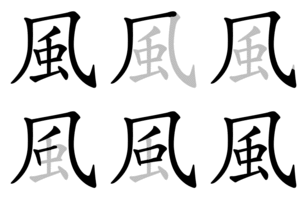 | |||
Han character
風 (Kangxi radical 182, 風+0, 9 strokes, cangjie input 竹弓竹中戈 (HNHLI) or 竹弓一中戈 (HNMLI), four-corner 77210, composition ⿵𠘨䖝)
Derived characters
Descendants
References
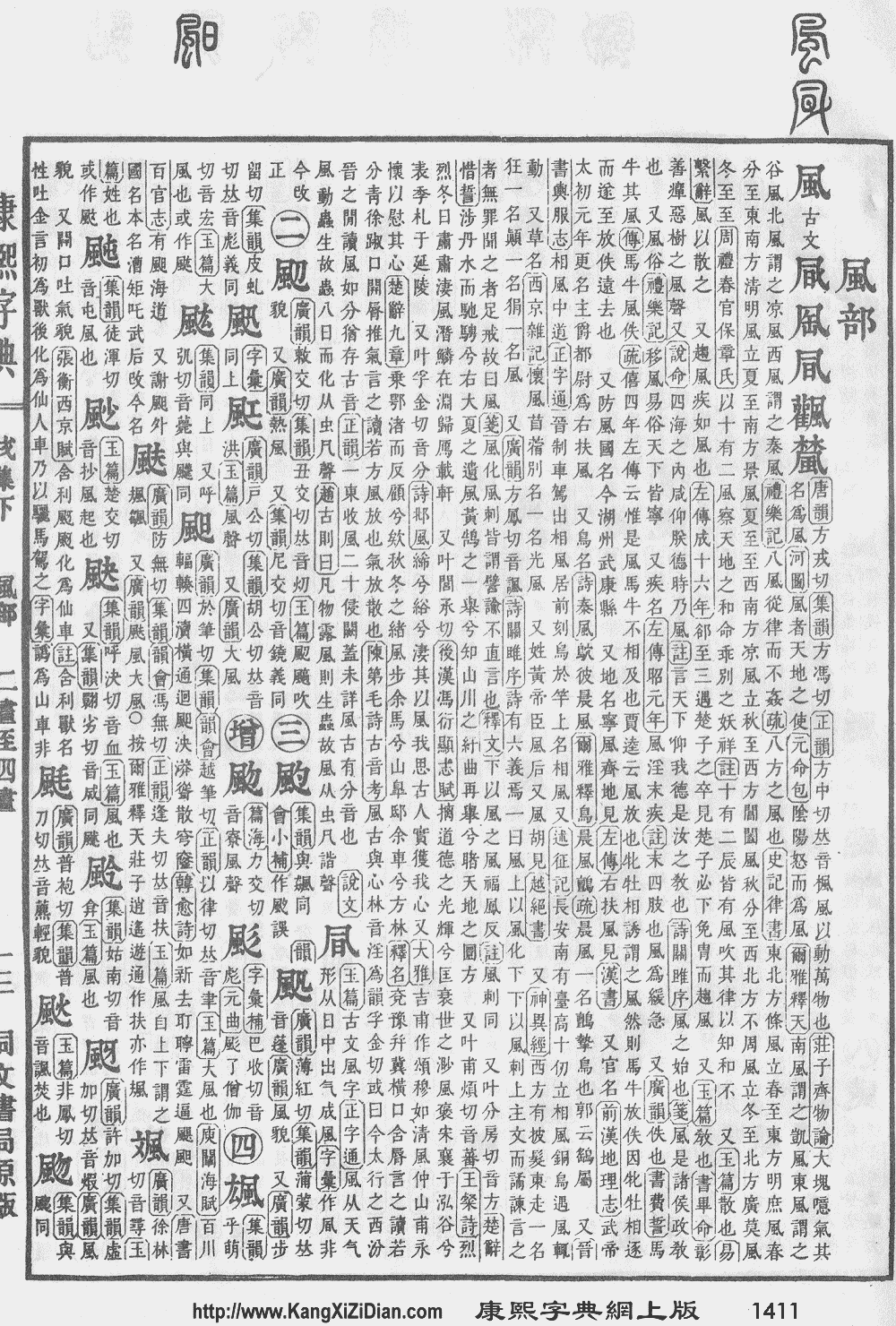
- KangXi: page 1411, character 1
- Dai Kanwa Jiten: character 43756
- Dae Jaweon: page 1930, character 20
- Hanyu Da Zidian (first edition): volume 7, page 4480, character 1
- Unihan data for U+98A8
Chinese
| trad. | 風 | |
|---|---|---|
| simp. | 风 | |
| alternative forms | ||
Glyph origin
| Historical forms of the character 風 | ||||||
|---|---|---|---|---|---|---|
| Shang | Western Zhou | Warring States | Shuowen Jiezi (compiled in Han) | Liushutong (compiled in Ming) | ||
| Oracle bone script | Bronze inscriptions | Chu slip and silk script | Qin slip script | Ancient script | Small seal script | Transcribed ancient scripts |
 |
 |
 |
 |
 |
 |
 |
Phono-semantic compound (形聲, OC *plum, *plums) : phonetic 凡 (OC *bom) + semantic 虫 (“insects”). Ancient Chinese people thought that insects appear with wind. (Insects refer to any kind of animal, such as tigers (大蟲)).
In the oracle bone script, the character 鳳 (OC *bums, “male fenghuang”) was phonetically borrowed to represent 風 (OC *plum, *plums). The right part of the bronze inscription of the character consists of phonetic 凡 (OC *bom) at the top, and three parts depicting the fur on the tail of the male fenghuang at the bottom. Subsequent forms of 風 are based on the right part of its bronze inscription, with two of the three threads of "fur" removed for simplification. The 虫 in the Chu script and Qin script of 風 was likely a result of further simplification of the "fur". Shuowen misinterpreted the character 風 by associating it with insects. (Li, 2012)
Etymology
Possibly from Proto-Sino-Tibetan *buŋ (“wind”) (STEDT). Velar nasal final -ŋ, restored later in Middle Chinese (Schuessler, 2007), is preserved in cognates like Proto-Central Naga *m-puŋ, Jingpho mabung, nbung, Drung nvmbeung.
Pronunciations 1, 2, and 3 are all cognates; with both 2 and 3 evolving from *prəm-s, exoactive (with causative suffix -s) of *prəm (Schuessler, 2007). It is unclear how Old Chinese *prəm is related to Tibetan རླུང (rlung) and Proto-Tai *C̬.lɯmᴬ.
Korean 바람 (baram) may have been borrowed from Chinese (Zhao, 2007). The Chinese word has a wide range of extended meanings, and interestingly many of these have exact parallels in the Korean item. Compare Chinese 風流 and 風騷 with Korean 바람둥이 (baramdung'i).
Cognate with:
- 飛廉 (OC *pɯl ɡ·rem, “wind god”)
- 蜚蠊 (OC *pɯlʔ/bɯls ɡ·rem, “cockroach”) (note the preservation of the -r- infix in Old Chinese through disyllabification, also 嵐 (OC *b·ruːm), 葻 (OC *b·uːm))
- 瘋 (OC *plum, “mad, insane”)
- 諷 (OC *plums, “to mock, to advise”)
- 帆 (OC *bom, *boms, “sail”)
The development from Old Chinese to Middle Chinese was irregular, driven by dissimilation of the initial and coda bilabial consonants.
Pronunciation 1
Definitions
風
- wind (Classifier: 陣/阵 m; 股 m)
- 風雨/风雨 ― fēngyǔ ― wind and rain; hardships
- 狂風/狂风 ― kuángfēng ― gale
- 外面風很大/外面风很大 ― wàimiàn fēng hěn dà ― It's very windy outside.
- 蘀兮蘀兮,風其吹女。叔兮伯兮,倡予和女。 [Classical Chinese, trad.]
- From: The Classic of Poetry, c. 11th – 7th centuries BCE, translated based on James Legge's version
- Tuò xī tuò xī, fēng qí chuī nǚ. Shū xī bó xī, chàng yǔ hé nǚ. [Pinyin]
- Ye withered leaves! Ye withered leaves! How the wind is blowing you away! O ye uncles, Give us the first note, and we will join in with you.
萚兮萚兮,风其吹女。叔兮伯兮,倡予和女。 [Classical Chinese, simp.]
- to air-dry
- (in compounds) air-dried
- 風雞/风鸡 ― fēngjī ― air-dried chicken
- general mood; custom
- 天子省風以作樂,器以鐘之,輿以行之。 [Classical Chinese, trad.]
- From: Commentary of Zuo, c. 4th century BCE, translated based on James Legge's version
- Tiānzǐ xǐnɡfēng yǐ zuòyuè, qì yǐ zhōng zhī, yú yǐ xíng zhī. [Pinyin]
- The son of Heaven examines the manners [of the people], to guide him in making his music. In his instruments he collects the notes, and by those notes the music goes forth.
天子省风以作乐,器以钟之,舆以行之。 [Classical Chinese, simp.]
- demeanour
- cultivation; moralisation
- 風教/风教 ― fēngjiào ― cultivation
- 王曰:「嗚呼!說,四海之內,咸仰朕德,時乃風。股肱惟人,良臣惟聖。」 [Classical Chinese, trad.]
- From: Forged Old Text of the Book of Documents, circa 3rd – 4th century CE
- Wáng yuē: “Wūhū! Shuō, sìhǎi zhī nèi, xián yǎng zhèn dé, shí nǎi fēng. Gǔgōng wéi rén, liáng chén wéi shèng.” [Pinyin]
- The king said, "Oh! Yue, that all within the four seas look up to my virtue is owing to you. As his legs and arms form the man, so does a good minister form the sage (king)."
王曰:“呜呼!说,四海之内,咸仰朕德,时乃风。股肱惟人,良臣惟圣。” [Classical Chinese, simp.]
- style; manner
- (in compounds) scene; scenery
- news; information
- love; affection; to become sexually attracted; to copulate
- 風月/风月 ― fēngyuè ― romance
- 風情/风情 ― fēngqíng ― amorous feelings
- 風馬牛不相及/风马牛不相及 ― fēng mǎ niú bù xiàngjí ― irrelevant
- 馬牛其風,臣妾逋逃,勿敢越逐,祗復之,我商賚汝。乃越逐不復,汝則有常刑!無敢寇攘,逾垣牆,竊馬牛,誘臣妾,汝則有常刑! [Classical Chinese, trad.]
- From: The Book of Documents, circa 7th – 4th centuries BCE
- Mǎ niú qí fēng, chénqiè būtáo, wù gǎn yuè zhú, zhī fù zhī, wǒ shāng lài rǔ. Nǎi yuè zhú bù fù, rǔ zé yǒu chángxíng! Wúgǎn kòurǎng, yú yuánqiáng, qiè mǎ niú, yòu chénqiè, rǔ zé yǒu chángxíng! [Pinyin]
- When the horses or cattle are seeking one another, or when your followers, male or female, abscond, presume not to leave the ranks to pursue them. But let them be carefully returned. I will reward you (among the people) who return them according to their value. But if you leave your places to pursue them, or if you who find them do not restore them, you shall be dealt with according to the regular punishments. And let none of you presume to commit any robbery or detain any creature that comes in your way, to jump over enclosures and walls to steal (people's) horses or oxen, or to decoy away their servants or female attendants. If you do so, you shall be dealt with according to the regular punishments.
马牛其风,臣妾逋逃,勿敢越逐,祗复之,我商赉汝。乃越逐不复,汝则有常刑!无敢寇攘,逾垣墙,窃马牛,诱臣妾,汝则有常刑! [Classical Chinese, simp.]
- dissolute; promiscuous
- ungrounded; baseless
- one of the three sections of Shijing, consisting of ballads
- (in general) folk song; ballad
- (obsolete) Alternative form of 瘋/疯 (fēng, “mad; insane”).
- 風病/风病 ― fēngbìng ― psychiatric illness
- 樵子聞言,仰天大笑道:「你原來是個風和尚。」行者道:「我不風啊,這是老實話。」 [Written Vernacular Chinese, trad.]
- From: Wu Cheng'en, Journey to the West, 16th century CE
- Qiáozǐ wén yán, yǎngtiān dàxiào dào: “Nǐ yuánlái shì ge fēng héshàng.” Xíngzhě dào: “Wǒ bù fēng a, zhè shì lǎoshí huà.” [Pinyin]
- (please add an English translation of this example)
樵子闻言,仰天大笑道:“你原来是个风和尚。”行者道:“我不风啊,这是老实话。” [Written Vernacular Chinese, simp.]
- (traditional Chinese medicine) one of the "Six Excesses" (六淫) that cause diseases in traditional Chinese medicine
- (traditional Chinese medicine) a type of diseases that are typically acute
- (Cantonese) rumour
- (Hokkien) minty
- (Philippines Hokkien) spicy
- a surname. Feng; Fung
Synonyms
- (spicy):
Compounds
|
|
|
Descendants
Others:
Pronunciation 2
Definitions
風
- † to blow; to fan
- † to influence; to reform a misguided person through persuasion
- 風民/风民 ― fēngmín ― to cultivate the masses
Compounds
|
|
|
Pronunciation 3
Definitions
風
References
- “風”, in 漢語多功能字庫 (Multi-function Chinese Character Database), 香港中文大學 (the Chinese University of Hong Kong), 2014–
- Dictionary of Chinese Character Variants (教育部異體字字典), A04572
Japanese
Kanji
Readings
Compounds
- 風棘 (fūkyoku)
- 風馬牛 (fūbagyū)
- 風圧 (fūatsu)
- 風雲 (fūun)
- 風化 (fūka)
- 風害 (fūgai)
- 風紀 (fūki)
- 風景 (fūkei)
- 風月 (fūgetsu)
- 風車 (fūsha)
- 風邪 (fūja)
- 風習 (fūshū)
- 風信子 (fūshinshi)
- 風塵 (fūjin)
- 風雪 (fūsetsu)
- 風船 (fūsen)
- 風俗 (fūzoku)
- 風袋 (fūtai)
- 風潮 (fūsen)
- 風体 (fūtei), 風体 (fūtai)
- 風土 (fūdo)
- 風物 (fūbutsu)
- 風味 (fūmi)
- 風流 (fūryū)
- 風林火山 (fūrinkazan)
- 風呂 (fūro)
- 秋風 (shūfū)
- 神風 (shinpū)
- 西風 (seifū)
- 南風 (nanpū)
- 東風 (tōfū)
- 北風 (hokufū)
- 東風 (ayu)
- 東風 (kochi)
- 南風 (hae)
- 風信子 (hiyashinsu)
Etymology 1
| Kanji in this term |
|---|
| 風 |
| かぜ Grade: 2 |
| kun’yomi |
From Old Japanese, from Proto-Japonic *kansay.
Derived from combining form kaza + い (i, ancient nominal particle).
Noun
風 • (kaze)
Derived terms
Etymology 2
| Kanji in this term |
|---|
| 風 |
| て Grade: 2 |
| kun’yomi |
Shift from Old Japanese 風 (ti), modern chi, found in some compounds.[1]
Etymology 3
| Kanji in this term |
|---|
| 風 |
| ふう Grade: 2 |
| on’yomi |
/puː/ → /fuː/
From Middle Chinese 風 (MC pɨuŋ).
In Old Japanese, this kanji was used to transcribe the 借音 (shakuon) kana of ⟨pu⟩ and ⟨bu⟩ in the Nihon Shoki (720 CE).
Noun
風 • (fū)
Etymology 4
| Kanji in this term |
|---|
| 風 |
| ふり Grade: 2 |
| irregular |
/puri/ → /furi/
From Old Japanese.
The 連用形 (ren'yōkei, “continuative or stem form”) of verb 振る (furu, “to swing”).
Alternative forms
Pronunciation
Derived terms
Suffix
風 • (-furi)
- This term needs a translation to English. Please help out and add a translation, then remove the text
{{rfdef}}.
Korean
Etymology
From Middle Chinese 風 (MC pɨuŋ).
| Historical readings |
|---|
|
Pronunciation
- (SK Standard/Seoul) IPA(key): [pʰuŋ]
- Phonetic hangul: [풍]