鼓
See also: 皼
| ||||||||
| ||||||||
Translingual
| Stroke order | |||
|---|---|---|---|
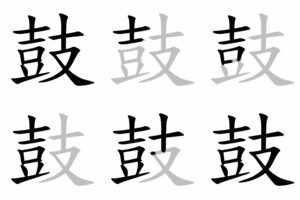 | |||
Han character
鼓 (Kangxi radical 207, 鼓+0, 13 strokes, cangjie input 土廿十水 (GTJE), four-corner 44147, composition ⿰壴支)
- Kangxi radical #207, ⿎.
References
- KangXi: page 1526, character 1
- Dai Kanwa Jiten: character 48330
- Dae Jaweon: page 2061, character 15
- Hanyu Da Zidian (first edition): volume 7, page 4763, character 1
- Unihan data for U+9F13

Chinese
| simp. and trad. |
鼓 | |
|---|---|---|
| 2nd round simp. | 壴 | |
| alternative forms | ||
Glyph origin
| Historical forms of the character 鼓 | |||
|---|---|---|---|
| Shang | Western Zhou | Shuowen Jiezi (compiled in Han) | Liushutong (compiled in Ming) |
| Oracle bone script | Bronze inscriptions | Small seal script | Transcribed ancient scripts |
 |
 |
 |
 |
Characters in the same phonetic series (鼓) (Zhengzhang, 2003)
Ideogrammic compound (會意) : 壴 (“drum”) + 支 (“hand holding drumstick”).
Etymology
Area word; compare Proto-Tai *klɔŋᴬ (“drum”), Saek [script needed] (tlɔɔŋᴬ¹), Proto-Hlai *laŋ¹ (“drum”), Proto-Wa (*kloʔ, "bronze-drum") (Schuessler, 2007).
瞽 (OC *kʷaːʔ, “blind man; musician”) is a derivative.
Pronunciation

鼓
Definitions
鼓
- (music) drum (Classifier: 面 m)
- to drum; to beat a drum
- 公將鼓之。劌曰:未可。齊人三鼓。劌曰:可矣。 [Classical Chinese, trad.]
- From: Commentary of Zuo, c. 4th century BCE
- Gōng jiāng gǔ zhī. Guì yuē: wèikě. Qí rén sān gǔ. Guì yuē: kě yǐ. [Pinyin]
- When the Duke was about to sound the drum for the attack, Tsao said, "Not yet." When the men of Qi had drummed thrice, Tsao said, "Now we can drum."
公将鼓之。刿曰:未可。齐人三鼓。刿曰:可矣。 [Classical Chinese, simp.]- 於是鼓之右,婦人大笑。孫子曰:「約束不明,申令不熟,將之罪也。」復三令五申而鼓之左,婦人復大笑。 [Classical Chinese, trad.]
- From: The Records of the Grand Historian, by Sima Qian, c. 91 BCE
- Yúshì gǔ zhī yòu, fùrén dàxiào. Sūnzǐ yuē: “Yuēshù bùmíng, shēnlìng bù shú, jiāng zhī zuì yě.” Fù sānlìngwǔshēn ér gǔ zhī zuǒ, fùrén fù dàxiào. [Pinyin]
- (please add an English translation of this example)
于是鼓之右,妇人大笑。孙子曰:“约束不明,申令不熟,将之罪也。”复三令五申而鼓之左,妇人复大笑。 [Classical Chinese, simp.]
- (literary) to play; to perform; to sound (a musical instrument)
- 鼓鐘欽欽,鼓瑟鼓琴。笙磬同音。 [Pre-Classical Chinese, trad.]
- From: The Classic of Poetry, c. 11th – 7th centuries BCE, translated based on James Legge's version
- Gǔ zhōng qīn qīn, gǔ sè gǔ qín. Shēng qìng tóngyīn. [Pinyin]
- His bells ring out k'in k'in;
His lutes, large and small, give their notes;
The tones of his organs and sounding stones are in unison.
鼓钟钦钦,鼓瑟鼓琴。笙磬同音。 [Pre-Classical Chinese, simp.]
- to beat; to clap
- 鼓掌 ― gǔzhǎng ― to clap hands
- 呂望之鼓刀兮,遭周文而得舉。甯戚之謳歌兮,齊桓聞以該輔。 [Classical Chinese, trad.]
- From: The Verses of Chu, 4th century BCE – 2nd century CE
- Lǚ wàng zhī gǔ dāo xī, zāo Zhōu wén ér dé jǔ. Níng qī zhī ōu gē xī, Qí Huán wén yǐ gāi fǔ. [Pinyin]
- (please add an English translation of this example)
吕望之鼓刀兮,遭周文而得举。甯戚之讴歌兮,齐桓闻以该辅。 [Classical Chinese, simp.]
- † to blast hot air for smelting
- to incite; to encourage
- to protrude; to bulge
- a surname
Synonyms
- (drum): (Hakka) 鼓仔
- (to protrude):
Compounds
Derived terms from 鼓
|
|
|
Japanese
Readings
Compounds
Etymology 1
| Kanji in this term |
|---|
| 鼓 |
| つづみ Grade: S |
| kun’yomi |
/tudumi1/ → /tudumi/ → /t͡sud͡zumi/ → /t͡suzumi/
From Old Japanese. First attested in the Kojiki of 712 CE.[1] From Proto-Japonic *tuntumi. Related to Okinawan 鼓 (chijin).
Alternative forms
Pronunciation
Noun
鼓 • (tsuzumi)
- generic name for musical instruments with a leather head that can be struck.
- a tsuzumi, hand drum with leather heads at both ends, used in Japanese traditional performing arts:
- a style of 家紋 (kamon, “family crest”), like the leather head of a tsuzumi
Etymology 2
Various nanori readings.
References
- “鼓”, in 日本国語大辞典 (Nihon Kokugo Daijiten, “Nihon Kokugo Daijiten”) (in Japanese), 2nd edition, Tōkyō: Shogakukan, 2000, →ISBN
- 2006, 大辞林 (Daijirin), Third Edition (in Japanese), Tōkyō: Sanseidō, →ISBN
- 1998, NHK日本語発音アクセント辞典 (NHK Japanese Pronunciation Accent Dictionary) (in Japanese), Tōkyō: NHK, →ISBN
Vietnamese
This article is issued from Wiktionary. The text is licensed under Creative Commons - Attribution - Sharealike. Additional terms may apply for the media files.