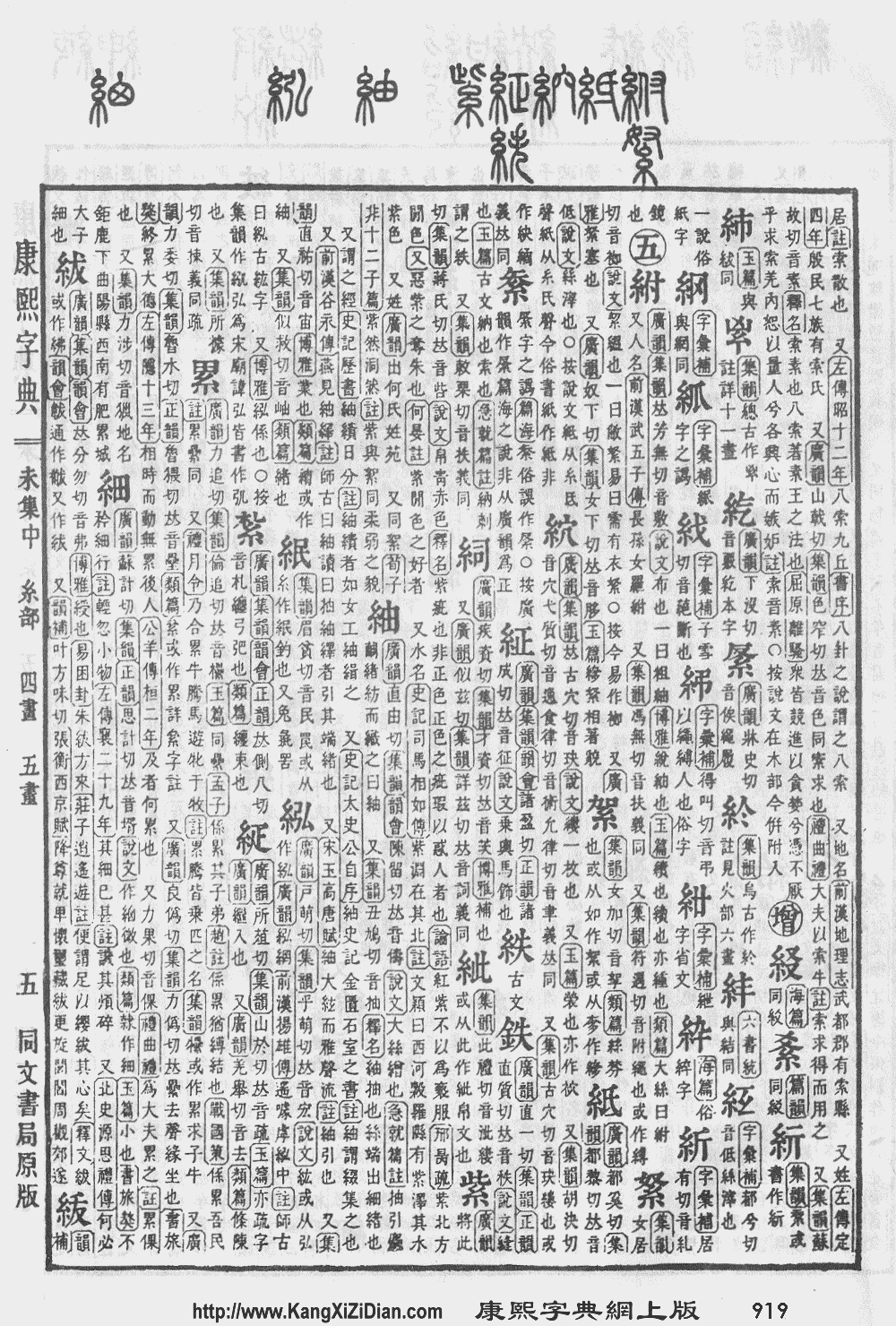
累

See also: 纍
累 U+7D2F, 累
CJK UNIFIED IDEOGRAPH-7D2F
← 紮
[U+7D2E]
CJK Unified Ideographs 細 →
[U+7D30]
累 U+F94F, 累
CJK COMPATIBILITY IDEOGRAPH-F94F
← 漏
[U+F94E]
CJK Compatibility Ideographs 縷 →
[U+F950]

Translingual

Stroke order
11 strokes

Han character

累 (Kangxi radical 120, 糸+5, 11 strokes, cangjie input 田女戈火 (WVIF), four-corner 60903, composition ⿱田糸)

Derived characters

References

Chinese

Glyph origin

Simplified from 纍 (léi) (畾 → 田 (tián)).

Folk etymology considers this character as an ideographic compound representing the tiredness after work. In ancient China, men were working in the field (田) while women sewed (糸).

Etymology

Various semantic fields can be distinguished:

“to add; to accumulate”
Related to 壘 (OC *rulʔ, “rampart; to build by piling rocks”), 厽 (OC *rolʔ), 絫 (OC *rolʔ) (Wang, 1982).
“to damage; exhausted; tired”
Related to 儽 (OC *ruːls, *rul, “tired”), 儡 (OC *ruːl, *ruːlʔ, *ruːls, “to injure”) (Schuessler, 2007). It can be compared with Khmer រួយ (ruəy, “tired; exhausted”), Mizo rawih (“weak; worn out; broken down”), Tibetan རུལ (rul, “to decay; to rot”), འབྲུལ ('brul, “to fall; to come out”), ཧྲུལ་པོ (hrul po, “torn; ragged”), སྲུལ (srul, “(archaic) to rot; to decompose”) (ibid.).
“to bind; to wind around”
See 纍 (OC *rul, *ruls).

Pronunciation 1

trad. 累/纍*
simp. 累


  • Dialectal data
Variety Location 累 (累積)
Mandarin Beijing /lei²¹⁴/
Harbin /lei²¹³/
Tianjin /lei¹³/
Jinan /luei⁵⁵/
Qingdao /le⁵⁵/
Zhengzhou /luei⁵³/
Xi'an /luei⁵³/
Xining /luɨ⁵³/
Yinchuan /luei⁵³/
Lanzhou /luei⁴⁴²/
Ürümqi /luei⁵¹/
Wuhan /nei⁴²/
Chengdu /nuei⁵³/
Guiyang /nuei⁴²/
Kunming /luei⁵³/
Nanjing /luəi²¹²/
Hefei /le²⁴/
Jin Taiyuan /luei⁵³/
Pingyao /luei⁵³/
Hohhot /luei⁵³/
Wu Shanghai /le²³/
Suzhou /le̞⁵¹/
Hangzhou /lei⁵³/
Wenzhou /lai³⁵/
Hui Shexian /le³⁵/
Tunxi
Xiang Changsha /lei⁴¹/
Xiangtan /nəi⁴²/
Gan Nanchang /lui²¹³/
Hakka Meixian /lui⁴⁴/
Taoyuan
Cantonese Guangzhou /løy²³/
Nanning /lui²⁴/
Hong Kong /løy²²/
Min Xiamen (Min Nan) /lui⁵³/
Fuzhou (Min Dong) /luɔi²⁴²/
Jian'ou (Min Bei) /ly²⁴/
Shantou (Min Nan) /lui⁵³/
Haikou (Min Nan) /lui²¹³/

Rime
Character 累
Reading # 1/2
Initial (聲) 來 (37)
Final (韻) 支 (12)
Tone (調) Rising (X)
Openness (開合) Closed
Division (等) III
Fanqie 力委切
Reconstructions
Zhengzhang
Shangfang
/liuᴇX/
Pan
Wuyun
/lʷiɛX/
Shao
Rongfen
/ljuɛX/
Edwin
Pulleyblank
/lwiə̆X/
Li
Rong
/liueX/
Wang
Li
/lǐweX/
Bernard
Karlgren
/lwie̯X/
Expected
Mandarin
Reflex
lěi
Expected
Cantonese
Reflex
leoi5
Baxter–Sagart system 1.1 (2014)
Character 累
Reading # 2/2
Modern
Beijing
(Pinyin)
lěi
Middle
Chinese
‹ ljweX ›
Old
Chinese
/*[r]ojʔ/
English accumulate

Notes for Old Chinese notations in the Baxter–Sagart system:

* Parentheses "()" indicate uncertain presence;
* Square brackets "[]" indicate uncertain identity, e.g. *[t] as coda may in fact be *-t or *-p;
* Angle brackets "<>" indicate infix;
* Hyphen "-" indicates morpheme boundary;

* Period "." indicates syllable boundary.
Zhengzhang system (2003)
Character 累
Reading # 2/3
No. 7733
Phonetic
component
畾
Rime
group
歌
Rime
subdivision
3
Corresponding
MC rime
絫
Old
Chinese
/*rolʔ/
Notes 同絫

Definitions

累

  1. to pile up; to heap up; to mount up; to accumulate
    積累/积累  ―  jīlěi  ―  to accumulate
    累計/累计  ―  lěijì  ―  to accumulate
  2. repeated; numerous; unremitting; continuous; persistent
    經年累月/经年累月  ―  jīngniánlěiyuè  ―  for years and years
  3. (obsolete) to repeat; to replicate; to overlap
  4. (obsolete) to add (to); to increase; to grow
  5. (obsolete) to amount (to); to sum up (to)
  6. (obsolete) Alternative form of 絫 (“ancient weight unit”).
  7. a surname

Compounds

Pronunciation 2

trad. 累/纍*
simp. 累


Note:
  • “To implicate”, “burden” and “to damage”:
    • lěi (Mainland standard, Taiwan variant);
    • lèi (Taiwan standard).
  • All other senses:
    • lèi.
Note:
  • lia6 - vernacular;
  • lei5 - literary.

  • Dialectal data
Variety Location 累 (連累)
Mandarin Beijing /lei⁵¹/
Harbin /lei⁵³/
Tianjin /lei⁵³/
Jinan /luei²¹/
Qingdao /le⁴²/
Zhengzhou /luei³¹²/
Xi'an /luei⁰/
Xining /luɨ⁵³/
Yinchuan /luei¹³/
Lanzhou /luei¹³/
Ürümqi /luei²¹³/
Wuhan /nei³⁵/
Chengdu /nuei¹³/
Guiyang /nuei²¹³/
Kunming /luei²¹²/
Nanjing /luəi⁴⁴/
Hefei /le⁵³/
Jin Taiyuan /luei⁴⁵/
Pingyao /luei³⁵/
Hohhot /luei⁵⁵/
Wu Shanghai /le²³/
Suzhou /le̞³¹/
Hangzhou /lei¹³/
Wenzhou /lai³⁵/
Hui Shexian /le²²/
Tunxi /li¹¹/
Xiang Changsha /lei⁵⁵/
/lei¹¹/
Xiangtan /nəi²¹/
Gan Nanchang /lui²¹/
Hakka Meixian /lui⁵³/
Taoyuan /lui⁵⁵/
Cantonese Guangzhou /løy²²/
Nanning /lui²²/
Hong Kong /løy²²/
Min Xiamen (Min Nan) /lui²²/
Fuzhou (Min Dong) /luɔi²⁴²/
Jian'ou (Min Bei) /ly⁴⁴/
Shantou (Min Nan) /lui³¹/
Haikou (Min Nan) /lui³³/

Rime
Character 累
Reading # 2/2
Initial (聲) 來 (37)
Final (韻) 支 (12)
Tone (調) Departing (H)
Openness (開合) Closed
Division (等) III
Fanqie 良僞切
Reconstructions
Zhengzhang
Shangfang
/liuᴇH/
Pan
Wuyun
/lʷiɛH/
Shao
Rongfen
/ljuɛH/
Edwin
Pulleyblank
/lwiə̆H/
Li
Rong
/liueH/
Wang
Li
/lǐweH/
Bernard
Karlgren
/lwie̯H/
Expected
Mandarin
Reflex
lèi
Expected
Cantonese
Reflex
leoi6
Zhengzhang system (2003)
Character 累
Reading # 3/3
No. 7735
Phonetic
component
畾
Rime
group
歌
Rime
subdivision
3
Corresponding
MC rime
累
Old
Chinese
/*rols/

Definitions

累

  1. to involve; to implicate; to embroil; to entangle; to hinder
    連累/连累  ―  liánlei  ―  to implicate
    累人累物 [Cantonese]  ―  leoi6 jan4 leoi6 mat6 [Jyutping]  ―  to bring burden on others
  2. (obsolete) burden; tribulation; affliction; problem
  3. (obsolete) to damage; to hurt; to do harm to; to stain; to sully
  4. (obsolete) to entrust; to delegate; to devolve
  5. to strain; to wear out; to cause to be tired
    別累著眼睛/别累着眼睛  ―  bié lèi zhe yǎnjīng  ―  Do not tire your eyes.
    1. to cause trouble to; to trouble (someone)
      真係唔好意思,累你白行一趟。 [Cantonese, trad.]
      真系唔好意思,累你白行一趟。 [Cantonese, simp.]
      zan1 hai6 m4 hou2 ji3 si1, leoi6 nei5 baak6 haang4 jat1 tong3. [Jyutping]
      I'm really sorry for making you come here for nothing.
  6. (obsolete) suffering; misery; harm; disaster
  7. (obsolete) fault; crime; slip; defect
  8. to work hard; to toil; to overwork
    我今天累了一整天。 [MSC, trad. and simp.]
    Wǒ jīntiān lèi le yī zhěng tiān. [Pinyin]
    I've been working hard all day today.
  9. tired; weary; fatigued; exhausted
    我很累。  ―  Wǒ hěn lèi.  ―  I'm tired.
    他會累得精疲力竭的。 [MSC, trad.]
    他会累得精疲力竭的。 [MSC, simp.]
    Tā huì lèi dé jīngpílìjié de. [Pinyin]
    He'll wear himself out.
  10. (obsolete) wife and children; one's family
  11. (Changsha Xiang, polite) please; asking for help
    累你幫下忙囉。 [Xiang, trad.]
    累你帮下忙啰。 [Xiang, simp.]
    From: 1998, 鮑厚星 et al. (editors), 長沙方言詞典, page 66
    lia6 nyi3 ban1 ha5 man2 lo [Wiktionary]
    Please help.

Synonyms

  • (tired):

Compounds

Pronunciation 3

trad. 累/纍*
simp. 累


Rime
Character 累
Reading # 2/2
Initial (聲) 來 (37)
Final (韻) 支 (12)
Tone (調) Departing (H)
Openness (開合) Closed
Division (等) III
Fanqie 良僞切
Reconstructions
Zhengzhang
Shangfang
/liuᴇH/
Pan
Wuyun
/lʷiɛH/
Shao
Rongfen
/ljuɛH/
Edwin
Pulleyblank
/lwiə̆H/
Li
Rong
/liueH/
Wang
Li
/lǐweH/
Bernard
Karlgren
/lwie̯H/
Expected
Mandarin
Reflex
lèi
Expected
Cantonese
Reflex
leoi6
Zhengzhang system (2003)
Character 累
Reading # 3/3
No. 7735
Phonetic
component
畾
Rime
group
歌
Rime
subdivision
3
Corresponding
MC rime
累
Old
Chinese
/*rols/

Definitions

累

  1. Used in 累贅/累赘 (léizhui, “cumbersome”).

Pronunciation 4

For pronunciation and definitions of 累 – see 纍 (“rope; to tie; bull in mating season”).
(This character, 累, is the simplified and variant traditional form of 纍.)
Notes:

Pronunciation 5

simp. and trad.
累


Definitions

累

  1. Only used in 謼遫累/呼遫累.

Pronunciation 6

simp. and trad.
累


Definitions

累

  1. Only used in 肥累.

Pronunciation 7

simp. and trad.
累


Definitions

累

  1. † Synonym of 裸 (luǒ, “bare; naked”).

Japanese

Kanji

累

(common “Jōyō” kanji, shinjitai kanji, kyūjitai form 纍)

  1. accumulate

Readings

Korean

Hanja

累 (eumhun 묶을 루 (mukkeul ru), South Korea 묶을 누 (mukkeul nu))

  1. Hanja form? of 루/누 (“tired”).
  2. Hanja form? of 루/누 (“implicate, involve”).
  3. Hanja form? of 루/누 (“bother”).

Vietnamese

Han character

累: Hán Nôm readings: lụy/luỵ, lủi, lũy/luỹ, mệt, luy

  1. This term needs a translation to English. Please help out and add a translation, then remove the text {{rfdef}}.
This article is issued from Wiktionary. The text is licensed under Creative Commons - Attribution - Sharealike. Additional terms may apply for the media files.