走
See also: 赱
| ||||||||
| ||||||||
Translingual
| Stroke order | |||
|---|---|---|---|
 | |||
| Stroke order | |||
|---|---|---|---|
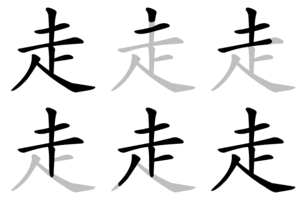 | |||
Han character
走 (Kangxi radical 156, 走+0, 7 strokes, cangjie input 土卜人 (GYO), four-corner 40801, composition ⿱土龰)
- Kangxi radical #156, ⾛.
- Shuowen Jiezi radical №26
References
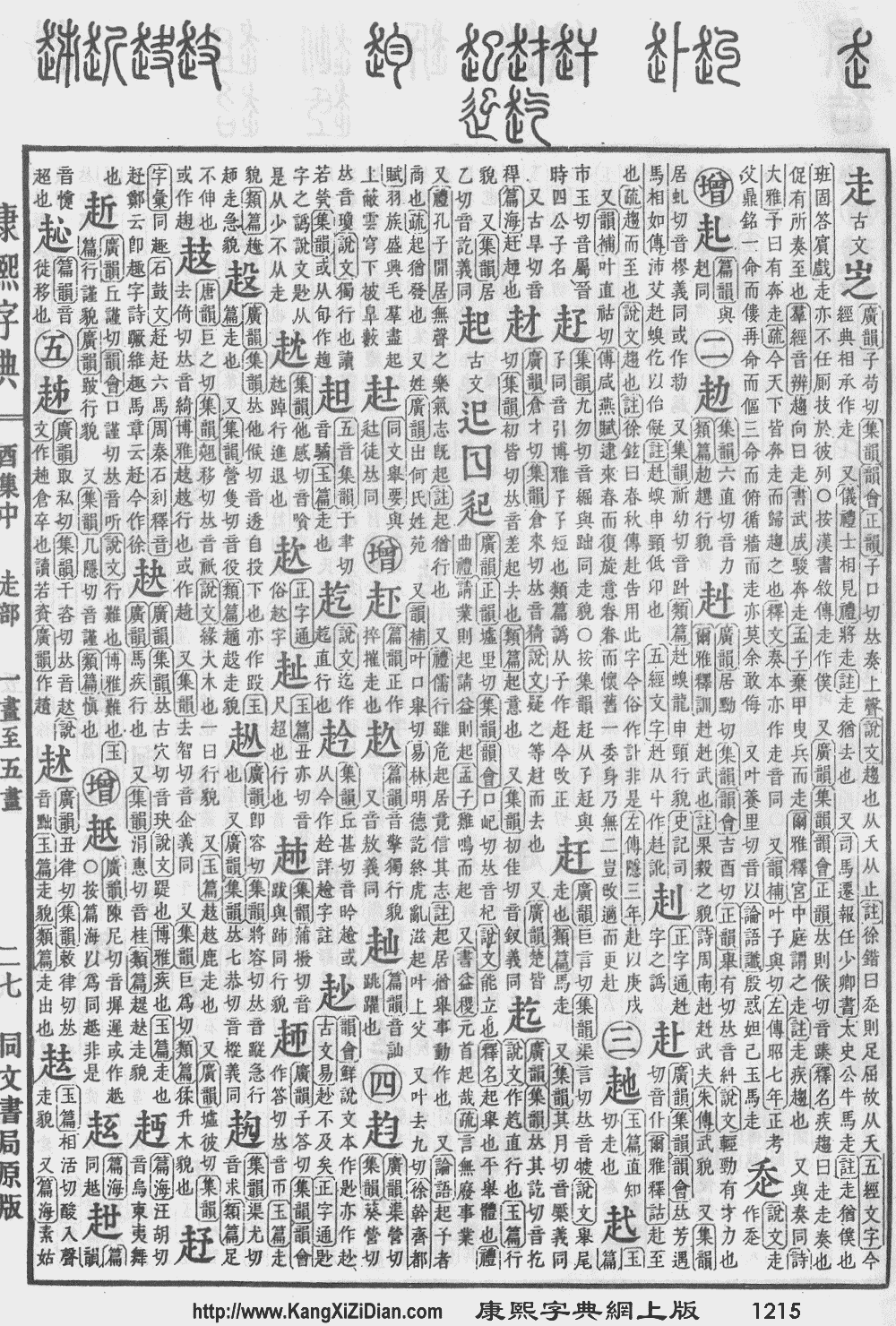
- KangXi: page 1215, character 1
- Dai Kanwa Jiten: character 37034
- Dae Jaweon: page 1683, character 4
- Hanyu Da Zidian (first edition): volume 5, page 3473, character 1
- Unihan data for U+8D70
Chinese
Glyph origin
| Historical forms of the character 走 | |||||||
|---|---|---|---|---|---|---|---|
| Shang | Western Zhou | Spring and Autumn | Warring States | Shuowen Jiezi (compiled in Han) | Liushutong (compiled in Ming) | ||
| Oracle bone script | Bronze inscriptions | Bronze inscriptions | Bronze inscriptions | Chu slip and silk script | Qin slip script | Small seal script | Transcribed ancient scripts |
 |
 |
 |
 |
 |
 |
 |
 |
Ideogrammic compound (會意) : 夭 (“young, running man”) + 止 (“foot”) – a running man. The top component (夭) simplified to the unrelated 土.
As with 圭, there are two separate vertical strokes, not a single one.
Etymology 1
| simp. and trad. |
走 | |
|---|---|---|
| alternative forms | 赱 𧺆 | |
Schuessler (2007) considers this to be part of a large Sino-Tibetan word family, including 搜 (OC *sru, “to move”), 速 (OC *sloːɡ, “quick”), 夙 (OC *suɡ, “morning”), 聳 (OC *sloŋʔ, “to excite”), 蔌 (OC *sloːɡ, “vegetables”), which derive from Proto-Sino-Tibetan *m-sow (“to arise; to awake”).
Pronunciation
Definitions
走
- to go; to walk; to go on foot
- (literary or dialectal Mandarin, Cantonese, Hakka, Min, Wu) to run; to jog
- 宋人有耕田者,田中有株,兔走,觸株折頸而死。 [Classical Chinese, trad.]
- From: Han Feizi, circa 2nd century BCE
- Sòng rén yǒu gēngtián zhě, tián zhōng yǒu zhū, tù zǒu, chù zhū zhé jǐng ér sǐ. [Pinyin]
- There was a farmer of Song who tilled the land, and in his field was a stump. One day a rabbit, racing across the field, bumped into the stump, broke its neck, and died.
宋人有耕田者,田中有株,兔走,触株折颈而死。 [Classical Chinese, simp.]
- (intransitive) to leave; to go away
- (literary) to run away; to flee
- 填然鼓之,兵刃既接,棄甲曳兵而走。 [Classical Chinese, trad.]
- From: Mencius, c. 4th century BCE
- Tiánrán gǔ zhī, bīngrèn jì jiē, qìjiǎyèbīng ér zǒu. [Pinyin]
- The soldiers move forward to the sound of the drums; and after their weapons have been crossed, on one side they throw away their coats of mail, trail their arms behind them, and run.
填然鼓之,兵刃既接,弃甲曳兵而走。 [Classical Chinese, simp.]
- to leak; to let out
- (of devices) to run; to work
- to visit; to call on
- to make a move
- (euphemistic) to pass away; to die
- to change; to lose original shape, flavour, etc.
- (Cantonese) to leave out (from a dish); to hold
- from; through
- a surname
Synonyms
- (to walk):
Dialectal synonyms of 走 (“to walk”) [map]
- (to run):
Dialectal synonyms of 跑 (“to run”) [map]
- (to leave):
Dialectal synonyms of 走 (“to leave (intransitive)”) [map]
| Variety | Location | Words |
|---|---|---|
| Formal (Written Standard Chinese) | 走, 離開, 離去 | |
| Mandarin | Taiwan | 走, 離開 |
| Jinan | 走 | |
| Wanrong | 走 | |
| Xi'an | 走 | |
| Yinchuan | 走 | |
| Xining | 走 | |
| Ürümqi | 走 | |
| Wuhan | 走 | |
| Chengdu | 走 | |
| Guiyang | 走 | |
| Nanjing | 走 | |
| Singapore | 走, 離開 | |
| Cantonese | Guangzhou | 走, 扯 |
| Hong Kong | 走, 扯, 撇, 閃 | |
| Penang (Guangfu) | 走 | |
| Singapore (Guangfu) | 走, 扯 | |
| Gan | Nanchang | 走 |
| Hakka | Meixian | 走 |
| Yudu | 走 | |
| Jin | Taiyuan | 走 |
| Min Nan | Taipei | 走 GT |
| Singapore (Hokkien) | 走 | |
| Singapore (Teochew) | 走 | |
| Wu | Danyang | 走 |
| Hangzhou | 走 | |
| Jinhua | 走 | |
| Note | GT - General Taiwanese (no specific region identified) | |
- (to die):
Synonyms of 走
|
|
|
Compounds
Derived terms from 走
|
|
|
Pronunciation
Definitions
走
- (Hokkien) Alternative form of 行 (kiâⁿ, “to walk”).
- 走不知路才會乎你騙騙去 走不知路才會為你來傷心 [Taiwanese Hokkien, trad.]
- From: 2017, 王俊傑 (lyrics and music), 走不知路, performed by 蔡秋鳳
- kiâⁿ m̄-chai lō͘ chiah ē hō͘ lí phiàn-phiàn--khì, kiâⁿ m̄-chai lō͘ chiah ē ūi lí lâi siong-sim [Pe̍h-ōe-jī]
- (please add an English translation of this example)
走不知路才会乎你骗骗去 走不知路才会为你来伤心 [Taiwanese Hokkien, simp.]
Japanese
Compounds
| Kanji in this term |
|---|
| 走 |
| そう Grade: 2 |
| on’yomi |
Vietnamese
This article is issued from Wiktionary. The text is licensed under Creative Commons - Attribution - Sharealike. Additional terms may apply for the media files.